
Will AI Replace Early Childhood Teachers? A Realistic View on AI in ECCE
Explore the real truth about AI in ECCE and whether technology can replace early childhood teachers. Learn how AI may support education, but human connection, empathy, and emotional guidance remain irreplaceable in early learning.
LevelUp Online Education
5/19/20265 min read
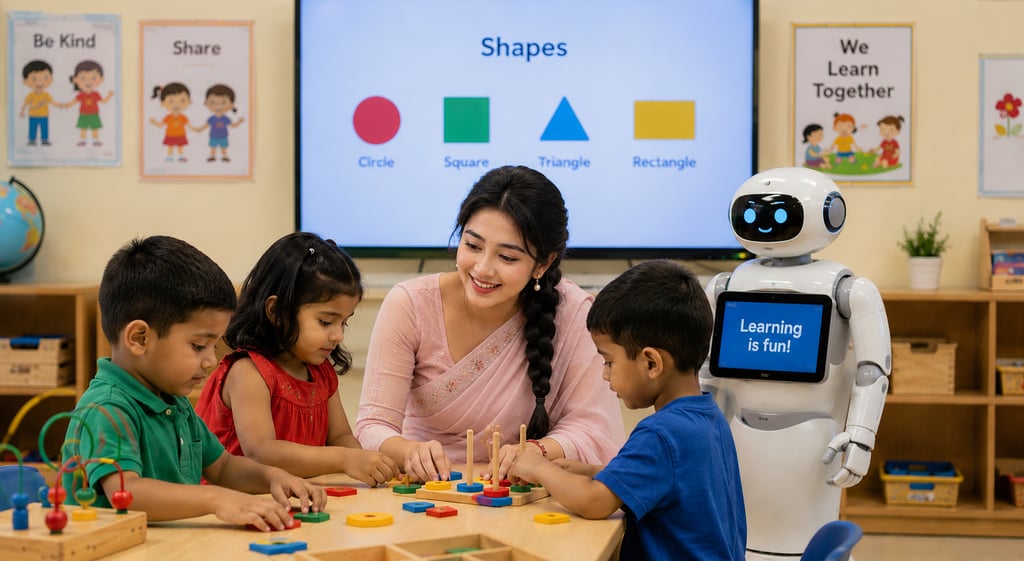
Artificial Intelligence is changing almost every industry today. From healthcare and banking to marketing and customer service, machines are becoming smarter and faster. Naturally, this raises an important question in education too: Will AI replace teachers in the future?
In the world of Early Childhood Care and Education (ECCE), this question feels even more emotional and personal. Parents wonder whether technology will one day teach their children. Teachers fear losing their importance. Schools are experimenting with smart learning apps, AI-powered lesson planning, and interactive educational tools.
But when we look closely at real classrooms, real children, and real emotions, the answer becomes much more realistic and balanced. The future of AI in ECCE is not about replacing teachers. It is about redefining how teachers work and how children learn.
Why This Question Is Becoming So Common
Today’s children are growing up surrounded by technology. Even toddlers know how to swipe screens, talk to voice assistants, and watch educational videos online. Schools are also introducing digital boards, AI-based assessments, and personalized learning platforms.
Because of this rapid growth, many people assume that teaching young children can eventually become automated. After all, if AI can answer questions, tell stories, track progress, and even generate worksheets instantly, why would schools still need teachers?
The reality, however, is much deeper than academic instruction.
Early childhood education is not just about teaching alphabets, numbers, or phonics. It is about emotional safety, social growth, confidence building, empathy, and human connection. And this is exactly where the limits of AI in ECCE become visible.
Young Children Learn Through Human Relationships
A preschool classroom is not a corporate office where efficiency alone matters. Young children learn through attachment, trust, imitation, and emotional bonding.
When a child falls while playing, they do not need an AI chatbot. They need a warm teacher who comforts them.
When a shy child refuses to speak in class, they need emotional encouragement, patience, and understanding.
When two children fight over a toy, they need guidance about emotions, sharing, and empathy.
These situations happen every single day in ECCE classrooms. No machine can truly understand a child’s fear, insecurity, excitement, or emotional needs the way a caring educator can.
This is why discussions about AI in ECCE must remain realistic instead of fear-driven.
What AI Can Actually Do in ECCE
Although AI cannot replace teachers emotionally, it can definitely become a useful support system. In fact, many educators may benefit greatly from technology if it is used wisely.
1. Reducing Administrative Burden
Teachers often spend hours creating worksheets, preparing reports, organizing assessments, and documenting observations. AI tools can help automate repetitive tasks, saving valuable time.
Instead of spending late nights preparing basic materials, teachers can focus more on children’s emotional and developmental needs.
2. Personalized Learning Support
Every child learns differently. Some children understand concepts quickly, while others need repeated exposure. AI-powered learning systems can track progress and suggest activities according to a child’s pace.
This makes AI in ECCE helpful as an assistant rather than a replacement.
3. Language and Accessibility Support
AI tools can help children learn multiple languages, improve pronunciation, or access special learning aids. For children with learning differences, speech tools and interactive programs may provide additional support.
4. Helping Teachers Plan Better
AI can generate activity ideas, classroom themes, storytelling prompts, and learning resources. This can reduce teacher burnout and increase creativity in lesson planning.
However, none of these functions replace the emotional intelligence of a human educator.
The Biggest Limitation of AI: Emotional Intelligence
One major misunderstanding about technology is assuming intelligence and emotional understanding are the same thing. They are not.
AI can process information, but it cannot genuinely feel empathy. It cannot build authentic emotional trust with a child.
Imagine a preschooler crying because their mother dropped them at school for the first time. A teacher understands that this child may need physical reassurance, gentle conversation, eye contact, and patience.
A machine may recognize facial expressions or generate comforting words, but it cannot emotionally connect in a meaningful human way.
This emotional dimension is the foundation of ECCE itself. That is why even the most advanced developments in AI in ECCE still cannot replace the heart of teaching.
Real-World Concerns Teachers Are Facing
Many educators today feel anxious about AI because they already see technology changing workplaces. Some schools are reducing staff for cost-saving purposes. Others are heavily promoting digital learning.
These fears are understandable. But instead of resisting AI completely, teachers may benefit more from adapting to it intelligently.
The future teacher may not look exactly like the traditional teacher of the past. Educators who understand technology, emotional learning, child psychology, and creative facilitation will likely become even more valuable.
In reality, AI may replace repetitive systems, but not emotionally responsive educators.
Parents Still Value Human Teachers
Even after the rise of online learning during global lockdowns, many parents realized something important: children need human interaction.
Many families observed that young children struggled with attention, emotional engagement, social skills, and discipline during fully digital learning experiences. Screens alone could not replace classroom energy, peer relationships, or teacher warmth.
This real-world experience changed how many people view AI in ECCE today. Technology can support learning, but human relationships remain central to healthy childhood development.
The Future Classroom: Humans + Technology Together
The most realistic future is not “AI versus teachers.” It is teachers working alongside intelligent tools.
Future ECCE classrooms may include:
AI-assisted learning apps
Smart progress tracking systems
Interactive storytelling technologies
Speech and language development tools
Personalized activity recommendations
But alongside all this technology, children will still need:
Emotional reassurance
Human communication
Physical interaction
Social guidance
Creative play
Empathy and affection
A teacher’s role may evolve from simply delivering information to becoming a mentor, emotional guide, observer, and developmental facilitator.
This balanced perspective is the healthiest way to understand AI in ECCE.
Skills Future ECCE Teachers Must Develop
Instead of fearing replacement, educators should focus on becoming future-ready. The teachers who grow with technology will remain highly relevant.
Important future skills include:
Emotional intelligence
Communication skills
Creativity in teaching
Child psychology understanding
Digital literacy
Observation and assessment skills
Inclusive teaching methods
Technology may change teaching methods, but human-centered educators will continue to shape childhood experiences.
Can AI Ever Truly Replace a Preschool Teacher?
Realistically, no.
AI may become more advanced, interactive, and useful in classrooms. It may automate systems, personalize learning, and assist teachers in many ways. But replacing an early childhood teacher entirely is highly unlikely because ECCE is deeply emotional and relationship-based.
Young children do not just learn from instruction. They learn from facial expressions, affection, tone of voice, body language, emotional safety, and human interaction.
A child remembers the teacher who believed in them, comforted them, celebrated them, and made them feel safe — not the software that displayed learning content.
The future of AI in ECCE is not about removing teachers. It is about helping teachers become more effective while preserving the human connection children truly need.
Final Thoughts
Artificial Intelligence will continue transforming education in many ways. Ignoring it completely would be unrealistic. But fearing that it will entirely replace early childhood educators is equally unrealistic.
Technology can support learning. It can improve efficiency. It can assist with personalization. But it cannot replace human warmth, emotional bonding, empathy, or the deeply personal nature of early childhood teaching.
The real future lies in balance — where technology handles tools and systems, while teachers continue shaping hearts, minds, confidence, and emotional well-being.
And in that future, the role of compassionate educators may become more important than ever.
Northern Hills Supremus, A-306, Opp. Northern Heights, Dahisar East, Mumbai, Maharashtra 400068
LevelUp
admissions@leveluponline.in
© 2026. All rights reserved


levelup_online_education




LevelUp Online Education