Why Movement in Early Childhood Education Is Essential for Brain Development
Discover why movement in early childhood education plays a vital role in preschool brain development. Learn how active learning enhances cognitive growth, focus, and emotional regulation.
EARLY CHILDHOOD CARE EDUCATION
LevelUp Online Education
4/30/20264 min read
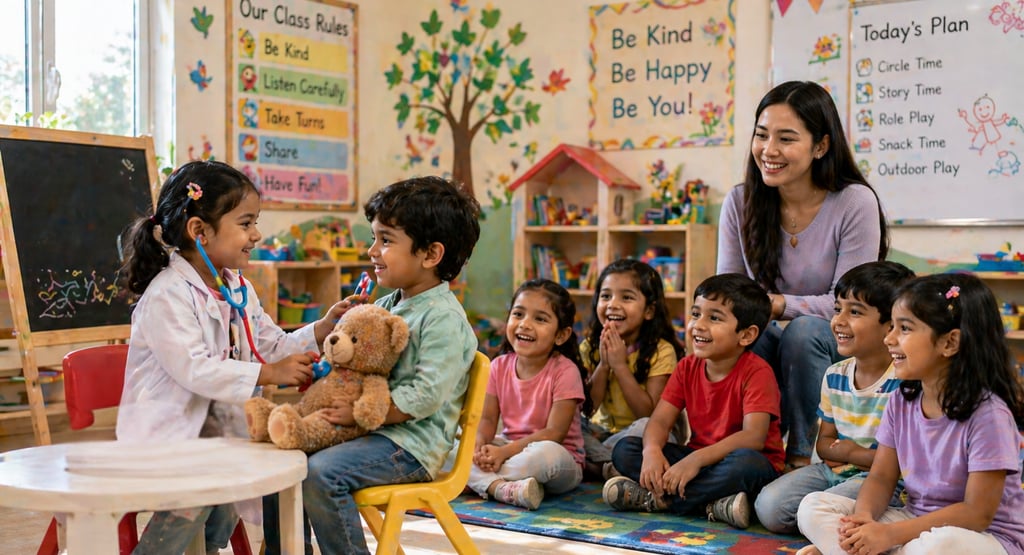
Walk into any preschool classroom, and you’ll often see children moving—jumping, running, clapping, or simply fidgeting. To an untrained eye, this might look like restlessness. But in reality, it is something far more powerful: learning in action.
At LevelUp Online Education, we emphasize that movement is not a distraction from learning—it is the foundation of it. Understanding the importance of movement in early childhood education helps educators and parents create environments where children don’t just sit and absorb information but actively build their brains through experience.
The Brain–Body Connection: More Powerful Than You Think
The early years (ages 2–6) are a period of rapid brain development. During this stage, neural connections are forming at an incredible pace. What many people overlook is that movement directly influences how these connections are built.
When a child moves, multiple areas of the brain are activated simultaneously:
The motor cortex controls physical movement
The cerebellum supports coordination and balance
The prefrontal cortex handles planning and decision-making
This is why movement in early childhood education is not just about physical growth—it is deeply tied to cognitive development.
For example, when a child jumps from one spot to another, they are:
Judging distance
Planning movement
Adjusting balance
Learning cause and effect
This is real learning—far beyond worksheets or rote memorization.
How Movement Enhances Cognitive Development
One of the biggest misconceptions in early education is that learning happens best when children sit still. In reality, the opposite is true.
1. Improves Memory and Retention
Children remember concepts better when they are physically involved. For instance, acting out a story or using body movements to learn numbers strengthens memory pathways.
This is why movement in early childhood education plays a crucial role in long-term retention.
2. Boosts Attention Span
Ironically, allowing children to move actually improves their ability to focus. Movement releases energy, making it easier for them to sit and concentrate afterward.
3. Strengthens Problem-Solving Skills
Physical play often involves trial and error. Whether it’s stacking blocks or navigating an obstacle course, children are constantly thinking, adjusting, and learning.
The Role of Movement in Emotional Regulation
Young children often struggle to express their emotions verbally. Movement becomes their natural outlet.
Running, jumping, or even dancing helps:
Release stress and frustration
Improve mood through endorphin release
Build self-regulation skills
This is another reason why movement in early childhood education is essential—it supports emotional well-being alongside cognitive growth.
A child who is allowed to move freely is often calmer, more engaged, and better prepared to learn.
Movement and Social Development: Learning Together
Movement-based activities often involve interaction—group games, dance, or collaborative play. These experiences teach children important social skills such as:
Taking turns
Following instructions
Working as a team
Understanding boundaries
Through movement, children learn how to navigate relationships in a natural and joyful way.
At LevelUp Online Education, we integrate structured and unstructured movement activities to ensure children develop both independence and cooperation.
Types of Movement That Support Brain Development
Not all movement is the same. Different types of physical activity contribute to different aspects of development.
1. Gross Motor Activities
These include running, jumping, climbing, and balancing. They build strength, coordination, and spatial awareness.
2. Fine Motor Activities
Activities like drawing, threading beads, or using scissors strengthen hand-eye coordination and prepare children for writing.
3. Cross-Lateral Movements
These involve using both sides of the body (like crawling or marching). They are especially important because they strengthen communication between the two hemispheres of the brain.
Incorporating all these forms ensures that movement in early childhood education is holistic and effective.
Why Traditional Classrooms Fall Short
Many traditional learning environments still prioritize sitting still and completing worksheets. While structure is important, excessive restriction of movement can:
Limit brain development
Reduce engagement
Increase behavioral challenges
Children are not designed to sit for long periods. Expecting them to do so goes against their natural developmental needs.
This is why modern ECCE approaches emphasize movement in early childhood education as a core teaching strategy—not an optional add-on.
Practical Ways to Integrate Movement in Learning
The good news is that incorporating movement doesn’t require expensive tools or large spaces. It simply requires a shift in mindset.
1. Learning Through Action
Instead of teaching numbers verbally, ask children to jump the number of times they count.
2. Story-Based Movement
Encourage children to act out stories—be a flying bird, a crawling caterpillar, or a jumping frog.
3. Brain Breaks
Short movement breaks between activities can reset attention and improve focus.
4. Music and Dance
Rhythmic movement enhances memory, coordination, and emotional expression.
These simple strategies make movement in early childhood education both practical and impactful.
The Science Behind Movement and Brain Growth
Research in neuroscience consistently shows that physical activity increases blood flow to the brain. This delivers oxygen and nutrients that are essential for brain function.
Movement also stimulates the release of Brain-Derived Neurotrophic Factor (BDNF), a protein that supports the growth of new neurons and strengthens existing connections.
In simple terms, movement literally helps the brain grow.
This scientific backing reinforces why movement in early childhood education should be a priority, not an afterthought.
The Long-Term Impact: Beyond Preschool
The benefits of movement extend far beyond the early years.
Children who experience movement-rich learning environments tend to:
Develop better academic skills
Show higher confidence levels
Have improved physical health
Demonstrate stronger emotional resilience
By prioritizing movement in early childhood education, we are not just supporting immediate learning—we are shaping lifelong success.
LevelUp’s Approach: Learning That Moves
At LevelUp Online Education, we believe that learning should never feel restrictive. Our teaching methodologies are designed to:
Integrate movement into daily activities
Encourage active exploration
Balance structure with freedom
Support whole-child development
We train educators to understand that a moving child is not a distracted child—but a developing brain in action.
Conclusion: Let Children Move, Let Them Learn
If there is one message educators and parents should take away, it is this:
Movement is not separate from learning—it is learning.
When children move, they think.
When they explore, they understand.
When they engage physically, they grow mentally.
Northern Hills Supremus, A-306, Opp. Northern Heights, Dahisar East, Mumbai, Maharashtra 400068
LevelUp
admissions@leveluponline.in
© 2026. All rights reserved


levelup_online_education




LevelUp Online Education