Understanding Scribbling in Early Childhood: Why “Random” Drawing Matters
Discover the importance of scribbling in early childhood and how it supports cognitive, emotional, and motor development. Learn why scribbling is not random but a powerful learning process.
EARLY CHILDHOOD & CARE EDUCATION
LevelUp Online Education
4/23/20264 min read
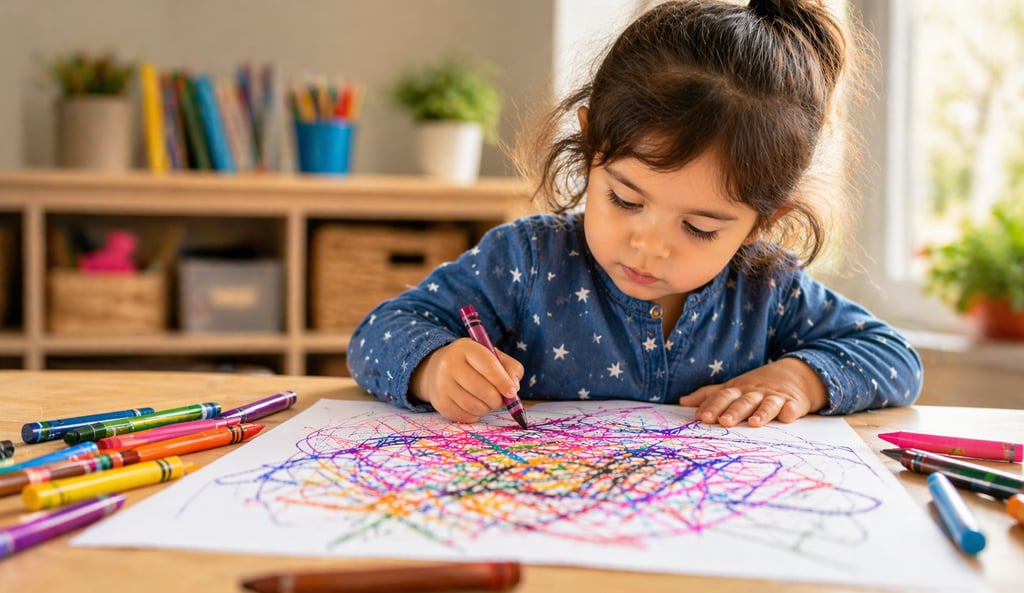
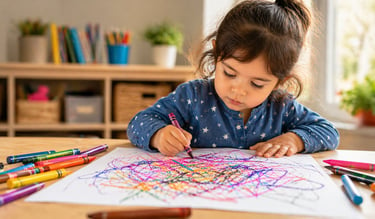
At first glance, a child’s scribbles may seem chaotic—lines going in all directions, shapes without meaning, and colors that don’t follow any rules. To an untrained eye, it might look like “just random drawing.”
But here’s the truth: there is nothing random about scribbling.
In fact, understanding the importance of scribbling in early childhood reveals a fascinating world of cognitive growth, emotional expression, and foundational learning. At LevelUp Online Education, we believe that every scribble tells a story—and more importantly, builds a child’s future readiness for learning.
Scribbling: The First Language Before Words
Before children can write letters or form words, they communicate through movement. Scribbling becomes their first visual language.
When a toddler picks up a crayon and starts making marks, they are not just “playing.” They are:
Exploring cause and effect
Expressing emotions
Practicing control over their body
This stage highlights the importance of scribbling in early childhood, as it lays the groundwork for both written and verbal communication.
A child may not say, “I feel excited,” but their energetic strokes across the page often reflect exactly that.
The Science Behind Scribbling Development
Scribbling follows a developmental pattern. It is not random—it evolves in stages:
1. Uncontrolled Scribbling (Around 1–2 years)
At this stage, children move their hands freely. The marks may go off the page, and there’s little control.
But even here, the importance of scribbling in early childhood is evident—children are learning that their actions create results.
2. Controlled Scribbling (Around 2–3 years)
Children begin to control their hand movements. You’ll notice repeated patterns—circles, lines, dots.
This repetition is not accidental. It shows growing motor control and brain coordination.
3. Named Scribbling (Around 3–4 years)
Now comes the magic. A child might point to their scribble and say, “This is Mama” or “This is a house.”
This is a powerful cognitive leap—symbolic thinking.
Understanding this progression reinforces the importance of scribbling in early childhood, as it connects physical movement with abstract thinking.
Building Fine Motor Skills Through Scribbling
One of the most overlooked benefits of scribbling is its role in physical development.
Every scribble strengthens:
Finger muscles
Hand-eye coordination
Grip control
These are the same skills needed later for:
Writing
Buttoning clothes
Using tools
At LevelUp, we emphasize that the importance of scribbling in early childhood goes beyond art—it directly impacts a child’s independence and daily functioning.
Scribbling and Brain Development: A Deeper Connection
Scribbling activates multiple areas of the brain simultaneously:
Motor cortex (movement)
Visual processing areas
Creative thinking centers
When a child draws a line and watches it appear, their brain is making connections between intention and outcome.
This is early problem-solving.
The importance of scribbling in early childhood lies in this integration—it strengthens neural pathways that support learning across subjects, including math and language.
Emotional Expression Through Scribbles
Children often express feelings they cannot verbalize through art.
A child who is:
Excited may scribble with bold, fast strokes
Calm may create gentle, repetitive patterns
Frustrated may press hard or scribble intensely
Instead of correcting or questioning, observing these patterns helps educators and parents understand the child better.
At LevelUp Online Education, we teach educators to see scribbling as emotional communication—another reason why the importance of scribbling in early childhood cannot be ignored.
Breaking a Common Myth: “Teach Them Proper Drawing Early”
Many adults unknowingly interrupt this natural process by saying:
“Draw properly”
“Stay inside the lines”
“Make it neat”
This approach can actually hinder development.
Why?
Because scribbling is about exploration, not perfection.
When we rush children into structured drawing, we limit creativity and self-expression. Recognizing the importance of scribbling in early childhood means allowing freedom before introducing structure.
Scribbling as the Foundation of Writing
Every letter a child will ever write begins with a scribble.
Think about it:
Straight lines → letters like L, T
Circles → letters like O, Q
Curves → letters like S
Scribbling is essentially “pre-writing practice.”
Children who are encouraged to scribble freely often develop:
Better writing fluency
Stronger pencil control
Greater confidence
This clearly highlights the importance of scribbling in early childhood as a precursor to academic success.
How Educators and Parents Can Support Scribbling
Understanding is one thing—but applying it is where the real impact lies.
Here’s how you can support this stage effectively:
1. Provide Open-Ended Materials
Offer crayons, chalk, markers, and large sheets of paper.
Avoid overly structured worksheets.
2. Focus on Process, Not Outcome
Instead of asking, “What is this?” say:
“Tell me about your drawing”
This validates their thinking.
3. Create a Safe, Judgment-Free Space
Let children explore without fear of “doing it wrong.”
4. Observe Without Interference
Sometimes, the best teaching happens when you simply watch.
At LevelUp Online Education, we train educators to implement these practices, reinforcing the importance of scribbling in early childhood in real classroom settings.
When Scribbling Becomes a Learning Tool
Scribbling doesn’t stay “just scribbling.” It evolves into:
Drawing shapes
Creating symbols
Writing letters
Forming words
Each stage builds on the previous one.
When educators understand this journey, they can guide children more effectively without disrupting natural development.
This is why the importance of scribbling in early childhood is a key concept in modern ECCE training programs.
The LevelUp Perspective: Seeing Meaning in Every Mark
At LevelUp Online Education, we encourage educators to shift their perspective:
Instead of asking,
“What is the child drawing?”
Ask,
“What is the child learning?”
Because every scribble represents:
A developing brain
A growing body
An expressive mind
Recognizing the importance of scribbling in early childhood allows educators to nurture children holistically—not just academically.
Conclusion: From Scribbles to Stories
What looks like random marks today becomes meaningful expression tomorrow.
Scribbling is not a phase to rush through—it is a foundation to build upon.
When we respect and support this stage, we empower children to:
Think creatively
Express confidently
Learn independently
So the next time you see a child scribbling, pause before you correct them.
Because in those lines, loops, and patterns—a powerful learning journey has already begun.
Northern Hills Supremus, A-306, Opp. Northern Heights, Dahisar East, Mumbai, Maharashtra 400068
LevelUp
admissions@leveluponline.in
© 2026. All rights reserved
levelup_online_education



LevelUp Online Education