
Understanding Eye Contact Avoidance in Children: Causes and Classroom Strategies
Learn the real reasons behind eye contact avoidance in children and how teachers can respond with empathy, awareness, and effective classroom strategies.
ECCE
LevelUp Online Education
4/22/20264 min read
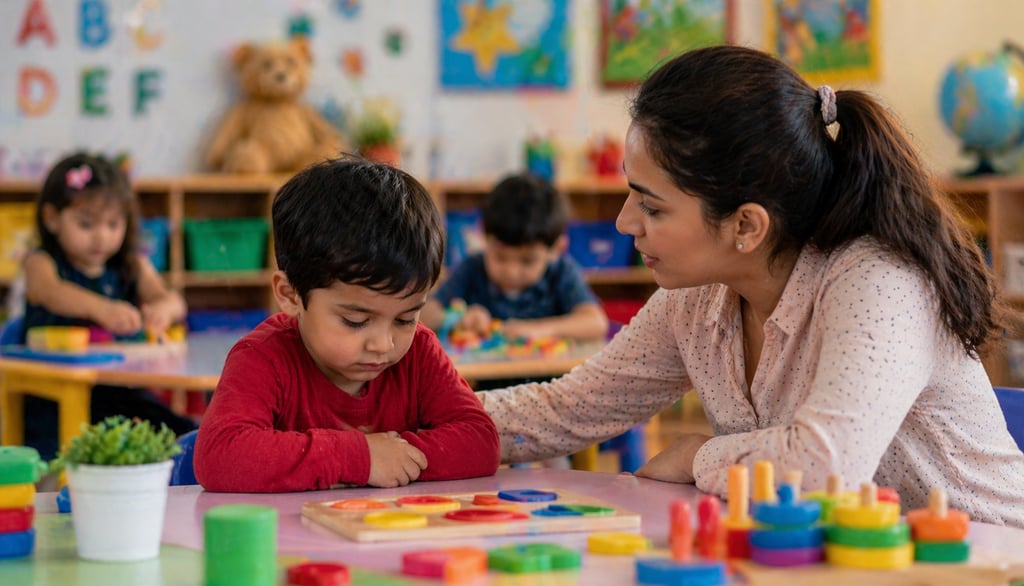
Introduction: Looking Beyond the Surface
In a classroom, eye contact is often seen as a sign of attention, respect, and understanding. Teachers naturally expect children to look at them while listening or responding. But what happens when a child consistently avoids eye contact?
Instead of assuming disinterest or disrespect, it is important to pause and reflect. Eye contact avoidance in children is not always a behavioral issue—it is often a message. A message about how the child feels, processes, and experiences the world.
At LevelUp Online Education, we believe that every child’s behavior has meaning. When teachers understand the deeper reasons behind actions, they can respond in ways that truly support development rather than suppress expression.
Eye Contact Is Not Universal
Before labeling a child’s behavior, we need to question our assumptions.
In many cultures and developmental contexts, direct eye contact is not always natural or comfortable. For some children, avoiding eye contact is not avoidance—it is regulation.
Understanding eye contact avoidance in children begins with recognizing that:
Not all children process social cues in the same way
Eye contact can feel overwhelming rather than engaging
Comfort levels vary based on personality, development, and environment
When teachers shift from judgment to curiosity, everything changes.
Reason 1: Emotional Overwhelm
For some children, making eye contact can feel intense. When emotions are already high—whether it is anxiety, fear, or even excitement—eye contact adds another layer of stimulation.
These children may:
Look down while speaking
Turn away when being addressed
Avoid eye contact during correction or questioning
This is not defiance. It is self-protection.
In such cases, eye contact avoidance in children becomes a coping mechanism to manage emotional overload.
Reason 2: Neurodiversity and Sensory Processing
Children with conditions like autism, ADHD, or sensory processing differences often experience eye contact differently.
For them:
Eye contact may feel physically uncomfortable
It may interfere with their ability to listen or think
They may focus better when not looking directly at someone
In fact, forcing eye contact can reduce their ability to process information.
Understanding eye contact avoidance in children in this context is crucial. It is not a lack of attention—it is a different way of engaging.
Reason 3: Lack of Confidence or Fear of Judgment
Imagine being unsure of your answer and being asked to look directly at the teacher while responding. For many children, this can feel intimidating.
Children who lack confidence may avoid eye contact because:
They fear making mistakes
They feel judged or evaluated
They are unsure of themselves
In such situations, eye contact avoidance in children reflects vulnerability, not disobedience.
Reason 4: Past Experiences and Emotional Safety
Children carry their experiences into the classroom.
A child who has faced:
Harsh discipline
Constant correction
Emotional neglect
may associate eye contact with pressure or fear.
Avoiding eye contact becomes a way to stay safe.
When we look at eye contact avoidance in children through this lens, it becomes clear that behavior is often rooted in emotional history.
Reason 5: Cultural and Family Influences
In some cultures, direct eye contact with adults is considered disrespectful. Children are taught to look down as a sign of politeness.
So when such children enter classrooms where eye contact is expected, they may seem disengaged—but they are actually following what they have learned at home.
Understanding eye contact avoidance in children also requires cultural sensitivity.
Why Misinterpretation Can Harm
When teachers misunderstand this behavior, they may:
Label the child as inattentive
Force eye contact
Use strict correction
This can lead to:
Increased anxiety
Reduced participation
Loss of trust
Instead of helping the child, it pushes them further away.
At LevelUp Online Education, we emphasize that the role of a teacher is not just to instruct—but to understand.
How Teachers Should Respond
1. Redefine Attention
A child does not need to look at you to be listening.
Observe:
Are they responding correctly?
Are they engaged in the task?
Are they following instructions?
If yes, then learning is happening.
2. Create Emotional Safety
Children open up when they feel safe.
You can:
Use a gentle tone
Avoid public correction
Encourage without pressure
When safety increases, eye contact may naturally improve.
3. Give Alternatives to Eye Contact
Instead of saying, “Look at me,” try:
“You can listen in your own way”
“It’s okay if you want to look at your book while I talk”
This respects the child’s comfort while maintaining connection.
4. Build Trust Slowly
Trust cannot be demanded—it must be built.
Spend time:
Talking one-on-one
Understanding the child’s personality
Showing patience
Over time, children feel more comfortable engaging, even if eye contact remains limited.
5. Work with Parents
Sometimes, understanding the home environment provides valuable insight.
Ask:
Is the child usually shy?
Are there cultural practices around eye contact?
Has the child experienced any recent changes?
This helps teachers respond with more awareness.
6. Avoid Forcing Eye Contact
This is one of the most important shifts.
Forcing eye contact:
Increases stress
Breaks trust
Can harm children with sensory sensitivities
Instead, focus on connection—not compliance.
The Deeper Lesson for Educators
When we understand eye contact avoidance in children, we learn a larger truth:
Not all learning looks the same.
Some children:
Listen without looking
Think deeply without responding immediately
Connect quietly rather than visibly
And that is okay.
Education must expand to include these differences—not suppress them.
How LevelUp Online Education Prepares Teachers
At LevelUp Online Education, we train educators to:
Understand child psychology deeply
Recognize hidden emotional cues
Respond with empathy and awareness
Create inclusive classrooms for all learners
Because real teaching is not about controlling behavior—it is about understanding it.
Conclusion: From Control to Compassion
The next time a child avoids eye contact, pause before reacting.
Ask yourself:
What is this child trying to communicate?
Northern Hills Supremus, A-306, Opp. Northern Heights, Dahisar East, Mumbai, Maharashtra 400068
LevelUp
admissions@leveluponline.in
© 2026. All rights reserved


levelup_online_education




LevelUp Online Education