The Gap Between Certification and Classroom Reality
Discover the gap between certification and classroom reality in ECCE and why practical teaching skills in ECCE are essential for every early educator’s success.
PRACTICAL TEACHING SKILSS
LevelUp Online Education
5/28/20264 min read
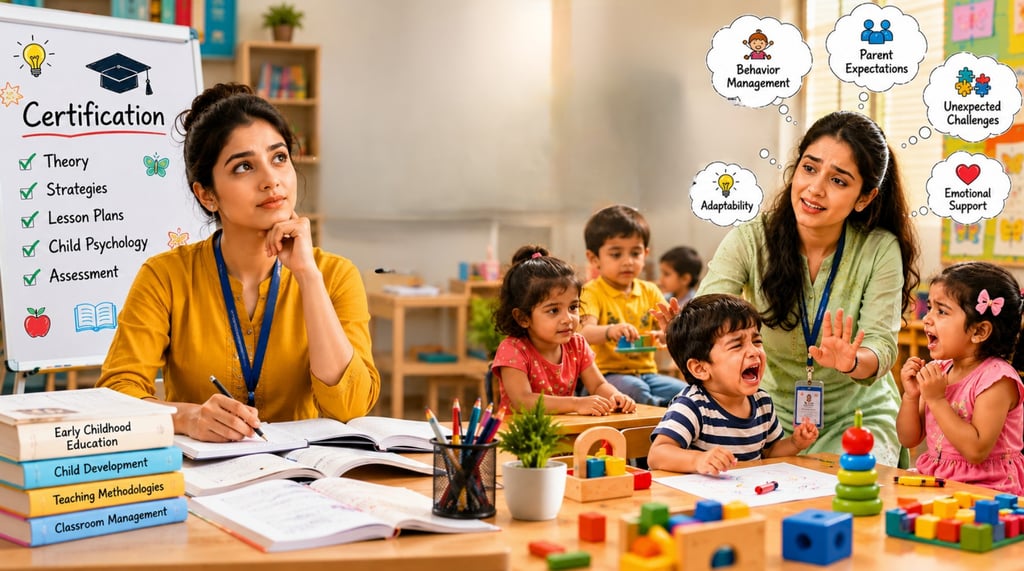

In today’s rapidly evolving education landscape, thousands of aspiring teachers complete professional certifications every year with dreams of becoming confident and impactful educators. Certifications provide knowledge, structure, and credibility. They introduce future teachers to theories of child development, curriculum planning, learning methodologies, and classroom management techniques.
But once many educators step into a real classroom for the first time, reality feels very different.
The cheerful textbook examples suddenly meet crying toddlers, distracted children, anxious parents, unpredictable classroom situations, and emotional exhaustion. Many educators realize that while certification gave them theoretical understanding, it did not fully prepare them for the emotional, practical, and human side of teaching.
This growing gap between certification and classroom reality is one of the biggest challenges in Early Childhood Care and Education (ECCE) today. More importantly, it highlights why practical teaching skills in ECCE are becoming increasingly important for every educator.
Why Certification Alone Is Not Enough
Professional certifications are undoubtedly valuable. They help educators understand educational frameworks, learning milestones, child psychology, lesson planning, and assessment methods. Certifications also build confidence and increase employability.
However, classrooms are living environments — not controlled academic spaces.
Children do not always respond according to theory. Every child has a different personality, learning pace, emotional need, and attention span. An educator may know multiple teaching strategies academically but still struggle to apply them effectively in real-time situations.
This is where practical teaching skills in ECCE become essential.
Real teaching requires emotional intelligence, patience, adaptability, observation skills, communication abilities, and confidence under pressure — qualities that are often developed only through hands-on experience.
The Reality Early Educators Often Face
Many newly certified teachers enter classrooms expecting structured learning environments similar to what they studied during training. Instead, they encounter situations like:
Children refusing to participate
Frequent emotional meltdowns
Difficulty handling mixed learning levels
Parents expecting instant academic results
Managing classroom behavior while teaching
Balancing emotional care with curriculum goals
Handling pressure and burnout
These situations cannot always be mastered through theory alone.
A teacher may understand child-centered learning conceptually but may still find it difficult to engage an energetic preschool group during a 40-minute session. Similarly, educators may know classroom management principles but struggle when multiple children demand attention simultaneously.
This is why practical teaching skills in ECCE must be developed alongside certification.
The Difference Between Knowing and Doing
One of the biggest misconceptions in education is assuming that knowledge automatically translates into effective teaching.
In reality, there is a huge difference between:
Knowing classroom management strategies
andActually calming a chaotic classroom
There is a difference between:
Learning about emotional development
andComforting an anxious child experiencing separation anxiety
And there is also a difference between:
Understanding lesson planning
andKeeping young learners engaged throughout the lesson
These differences define the true transition from “certified educator” to “effective educator.”
Key Differences Teachers Should Know
1. Theory Explains Children — Experience Understands Them
Certification programs teach developmental stages and behavioral theories. However, real classrooms expose educators to children with unique emotional needs, family backgrounds, personalities, and learning challenges.
An experienced teacher learns to observe subtle emotions, recognize silent struggles, and adapt teaching methods accordingly.
This deeper understanding develops through real interactions, not textbooks alone.
2. Lesson Planning Looks Different in Real Life
On paper, lesson plans often appear smooth and perfectly timed. In reality, young children may lose focus within minutes, become emotionally distracted, or respond differently than expected.
Teachers quickly learn that flexibility is one of the most important practical teaching skills in ECCE.
Sometimes the best learning moments happen outside the planned lesson.
3. Classroom Management Is Emotional Management
Many certification courses discuss discipline techniques and classroom rules. However, managing young learners is not just about control — it is about emotional connection.
Children cooperate better when they feel safe, heard, and valued.
Experienced educators understand how tone of voice, facial expressions, body language, and emotional patience directly impact classroom behavior.
4. Parents Are Part of the Classroom Experience
One area many certifications barely prepare teachers for is parent communication.
In ECCE, teachers regularly interact with concerned, emotional, protective, or highly ambitious parents. Educators must learn how to communicate professionally, handle expectations, provide reassurance, and maintain trust.
Strong communication becomes one of the most valuable practical teaching skills in ECCE.
5. Real Classrooms Demand Adaptability
No two teaching days are ever identical.
A planned activity may fail. A child may suddenly become upset. Technology may stop working. Group energy may completely shift.
Teachers who succeed in ECCE are often those who can adapt calmly and creatively.
This adaptability develops only through consistent classroom exposure and reflective practice.
Why Hands-On Training Matters in ECCE
The solution is not reducing the importance of certification. Instead, the focus should shift toward combining certification with stronger practical exposure.
Early educators benefit greatly from:
Classroom observations
Demo teaching sessions
Teaching internships
Role-play activities
Mentorship programs
Real classroom simulations
Reflection-based learning
These experiences help bridge the gap between theory and application.
Most importantly, they help teachers build confidence before entering professional classrooms independently.
The Emotional Side of Teaching Nobody Talks About
Teaching in ECCE is emotionally demanding.
Educators are not only teaching alphabets and numbers — they are shaping emotional security, confidence, communication skills, and social behavior during a child’s foundational years.
This responsibility can become overwhelming for educators who are technically qualified but emotionally unprepared.
Many new teachers experience:
Self-doubt
Anxiety
Fear of failure
Burnout
Emotional exhaustion
This is why emotional preparedness should become an important part of teacher training programs.
Developing practical teaching skills in ECCE also includes learning emotional resilience, stress management, and professional confidence.
What Makes an Effective Early Educator?
An effective educator is not simply someone who has completed a course.
A truly impactful teacher is someone who can:
Build emotional connections with children
Adapt teaching methods
Encourage curiosity
Create safe learning environments
Communicate with parents effectively
Handle challenges calmly
Continue learning beyond certification
The best educators combine theoretical knowledge with practical wisdom.
How Educators Can Bridge the Gap
Here are some practical ways early educators can strengthen their real-world teaching abilities:
Observe Experienced Teachers
Watching skilled educators handle classrooms provides valuable learning beyond textbooks.
Practice Reflection
After every teaching session, teachers should reflect on what worked, what failed, and what can improve.
Focus on Communication Skills
Clear communication with children, parents, and colleagues improves confidence and classroom effectiveness.
Accept Imperfection
No teacher performs perfectly every day. Growth comes through continuous learning and experience.
Keep Learning Beyond Certification
Workshops, webinars, mentorships, and classroom exposure help educators continuously improve their practical teaching skills in ECCE.
Conclusion
Certification is an important first step in becoming an educator, but it is not the final destination.
The real transformation happens inside classrooms — through daily interactions, emotional experiences, problem-solving, adaptability, and continuous learning.
The gap between certification and classroom reality exists because teaching is deeply human work. It requires far more than academic understanding.
For early educators, developing strong practical teaching skills in ECCE is what truly builds confidence, effectiveness, and long-term success in the classroom.
Northern Hills Supremus, A-306, Opp. Northern Heights, Dahisar East, Mumbai, Maharashtra 400068
LevelUp
admissions@leveluponline.in
© 2026. All rights reserved


levelup_online_education




LevelUp Online Education