Teaching Nouns, Verbs, and Adjectives with Jolly Grammar: Mastering Parts of Speech in Early Learning
Discover effective strategies for teaching nouns verbs and adjectives with Jolly Grammar in early learning. Learn how multisensory methods help children understand parts of speech in a fun and meaningful way.
PARTS OF SPEECH
LevelUp Online Education
3/13/20265 min read
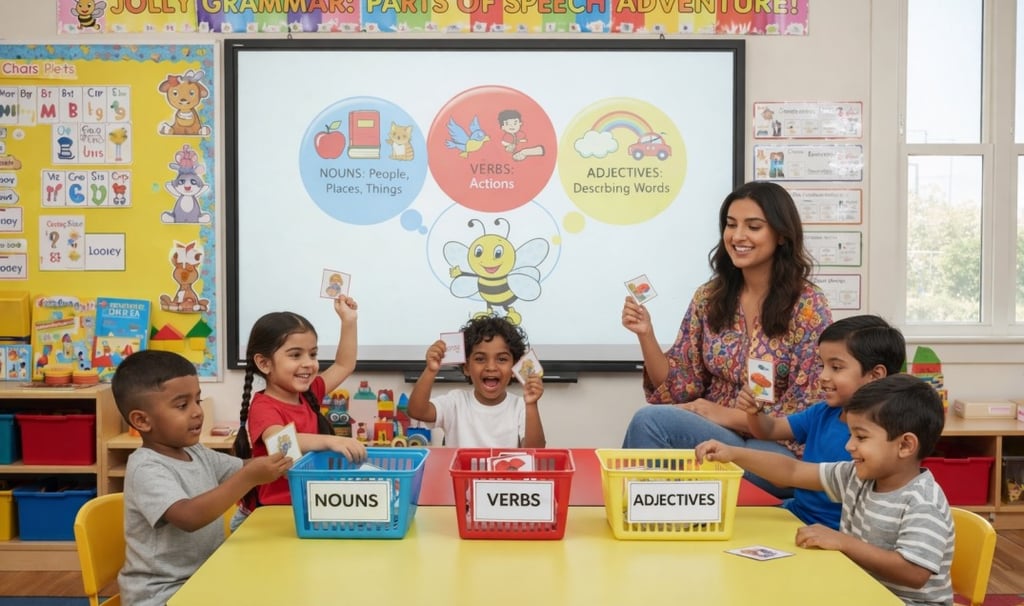
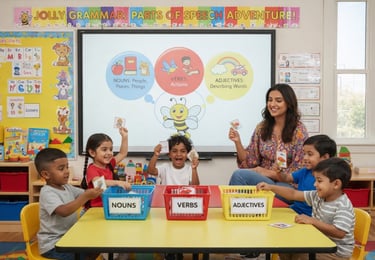
Understanding parts of speech is one of the most important foundations of language development in early childhood education. When children learn how words function in sentences, they begin to communicate more clearly, read with better comprehension, and develop stronger writing skills. However, teaching grammar to young learners can be challenging if it relies only on memorization and rules.
This is where multisensory approaches like teaching nouns verbs and adjectives with Jolly Grammar become highly effective. Instead of presenting grammar as abstract concepts, Jolly Grammar introduces parts of speech through actions, visual cues, stories, and structured practice. As a result, children are able to understand how language works in a natural and engaging way.
In early learning classrooms, teaching nouns verbs and adjectives with Jolly Grammar helps children connect words with real-life meaning, making grammar both memorable and enjoyable.
Understanding Parts of Speech in Early Learning
Parts of speech are categories that describe how words function in a sentence. In early childhood education, children are first introduced to the most basic and essential categories:
Nouns
Verbs
Adjectives
These three word types form the core of simple sentence construction. When children understand these categories, they begin to recognize how language communicates ideas, actions, and descriptions.
Teaching these concepts early also supports several developmental skills:
Vocabulary expansion
Sentence formation
Reading comprehension
Creative expression
Through structured methods such as teaching nouns verbs and adjectives with Jolly Grammar, young learners gradually build a strong grammatical foundation that supports their future literacy development.
Why Young Learners Need a Concept-Based Approach to Grammar
Young children learn best when information is connected to movement, sound, and visual patterns. Traditional grammar teaching often focuses on definitions and written exercises, which may not be suitable for early learners.
Children at the preschool and early primary level understand language more effectively when they can:
See examples in real contexts
Act out word meanings
Associate words with images or actions
Hear and repeat language patterns
This is why approaches like teaching nouns verbs and adjectives with Jolly Grammar emphasize active learning rather than passive memorization.
By engaging multiple senses, children can internalize grammatical concepts naturally rather than feeling overwhelmed by rules.
Teaching Nouns: Helping Children Identify People, Places, and Things
Nouns are usually the first part of speech introduced to young learners because they represent objects and ideas that children can easily observe in their environment.
A noun refers to:
A person (teacher, child, doctor)
A place (school, park, home)
A thing (book, chair, toy)
An animal (dog, bird, cat)
To help children understand nouns effectively, teachers should connect the concept with familiar surroundings. For example, children can be encouraged to identify nouns in the classroom, playground, or storybooks.
Activities that support noun learning include:
Object Identification
Children look around the classroom and name objects they see. This helps them understand that nouns represent real things.
Sorting Activities
Teachers can give children picture cards and ask them to group pictures of people, animals, places, and objects.
Story-Based Learning
Reading stories and asking children to identify nouns in the story helps them see how nouns function in sentences.
When educators focus on teaching nouns verbs and adjectives with Jolly Grammar, nouns are often introduced with visual cues and actions, helping children remember the concept more easily.
Teaching Verbs: Understanding Action Words
Verbs describe actions or states of being. For young learners, verbs are best introduced through movement and real-life examples.
Common verbs include:
Run
Jump
Eat
Write
Read
Play
Because verbs represent actions, children can physically demonstrate them. This makes verbs one of the most engaging parts of speech to teach.
Effective strategies include:
Action-Based Learning
Children act out verbs such as jumping, clapping, or running while saying the word aloud.
Verb Charades
Students guess the action being performed by another child.
Sentence Creation
Children create simple sentences such as:
The boy runs.
The dog jumps.
These activities allow learners to experience verbs through both language and movement.
In structured programs like teaching nouns verbs and adjectives with Jolly Grammar, verbs are often linked with specific gestures that represent action, helping children build strong memory connections.
Teaching Adjectives: Expanding Description and Expression
Adjectives add detail to language by describing nouns. They help children express how something looks, feels, or behaves.
Examples of adjectives include:
Big
Small
Happy
Fast
Red
Soft
When children learn adjectives, their vocabulary expands significantly. They begin to move from simple sentences to more descriptive ones.
For example:
Basic sentence
The dog runs.
With adjective
The small dog runs.
Teaching adjectives can be made meaningful through activities such as:
Observation Games
Children describe objects in the classroom using adjectives like color, size, and texture.
Picture Description
Students look at images and describe what they see.
Comparisons
Children compare objects using adjectives like big, bigger, biggest.
Approaches such as teaching nouns verbs and adjectives with Jolly Grammar encourage learners to actively describe the world around them, strengthening both grammar and vocabulary.
How Jolly Grammar Supports Multisensory Learning
Jolly Grammar builds on the phonics foundation introduced in early literacy programs and expands it into grammar learning.
One of its strengths is its multisensory teaching approach. Instead of relying solely on written explanations, it uses:
Actions
Symbols
Songs
Stories
Structured practice
Each part of speech is associated with a specific action or visual cue. These associations help children remember grammatical concepts more easily.
For example:
A noun may be represented through gestures pointing to objects.
A verb may involve action movements.
An adjective may include expressive gestures to represent description.
Through teaching nouns verbs and adjectives with Jolly Grammar, children are not simply memorizing definitions. They are experiencing grammar through movement, language, and interaction.
The Role of Sentence Construction in Grammar Learning
Once children understand nouns, verbs, and adjectives individually, they can begin to combine them to form meaningful sentences.
Sentence construction activities help learners see how different parts of speech work together.
Examples include:
Sentence Building Cards
Children arrange word cards to create sentences such as:
The happy dog runs.
Fill-in-the-Blank Exercises
The ___ cat jumps.
Children add an adjective like “small” or “playful.”
Creative Storytelling
Students create short stories using nouns, verbs, and adjectives.
These exercises strengthen grammatical understanding while also encouraging creativity and language development.
When teachers focus on teaching nouns verbs and adjectives with Jolly Grammar, sentence-building becomes a natural extension of grammar learning.
Common Challenges When Teaching Parts of Speech
Teaching grammar to young learners can present several challenges. Some children may confuse word categories, while others may struggle to understand abstract grammatical ideas.
Common challenges include:
Abstract Definitions
Young children may not easily understand definitions like “a noun is the name of a person, place, or thing.”
Limited Vocabulary
If children have a small vocabulary, identifying parts of speech becomes harder.
Lack of Context
Grammar exercises without meaningful context may feel confusing or boring.
Using interactive approaches like teaching nouns verbs and adjectives with Jolly Grammar helps overcome these challenges by making grammar visual, physical, and engaging.
Long-Term Benefits of Learning Parts of Speech Early
When children develop a strong understanding of parts of speech during their early years, it has a long-term impact on their academic development.
Some important benefits include:
Stronger Reading Skills
Understanding how words function helps children interpret sentences and comprehend texts more effectively.
Improved Writing Ability
Children who understand nouns, verbs, and adjectives can construct clearer and more expressive sentences.
Enhanced Vocabulary Development
Learning word categories encourages children to explore new vocabulary.
Confidence in Communication
Children become more confident when expressing ideas in both spoken and written language.
Programs focused on teaching nouns verbs and adjectives with Jolly Grammar support these outcomes by introducing grammar in a structured yet engaging way.
Conclusion
Grammar is a vital component of early literacy, but it must be introduced in ways that align with how young children naturally learn. By focusing on nouns, verbs, and adjectives first, educators help children understand the basic building blocks of language.
When grammar is taught through movement, interaction, and meaningful context, children develop a deeper understanding of how words work together in communication.
Approaches such as teaching nouns verbs and adjectives with Jolly Grammar provide a practical framework for introducing grammar concepts in early learning classrooms. By combining multisensory teaching methods with structured language practice, children gain the confidence and skills needed to become strong readers, writers, and communicators.
Northern Hills Supremus, A-306, Opp. Northern Heights, Dahisar East, Mumbai, Maharashtra 400068
LevelUp
admissions@leveluponline.in
© 2026. All rights reserved
levelup_online_education




LevelUp Online Education