School Readiness Pressure in ECCE: Are We Harming Children Early?
Discover how school readiness pressure in ECCE affects children’s emotional well-being, learning, and development, and why a balanced approach matters more than early academic success.
EARLY CHILDHOOD CARE & EDUCATION
LevelUp Online Education
4/10/20264 min read
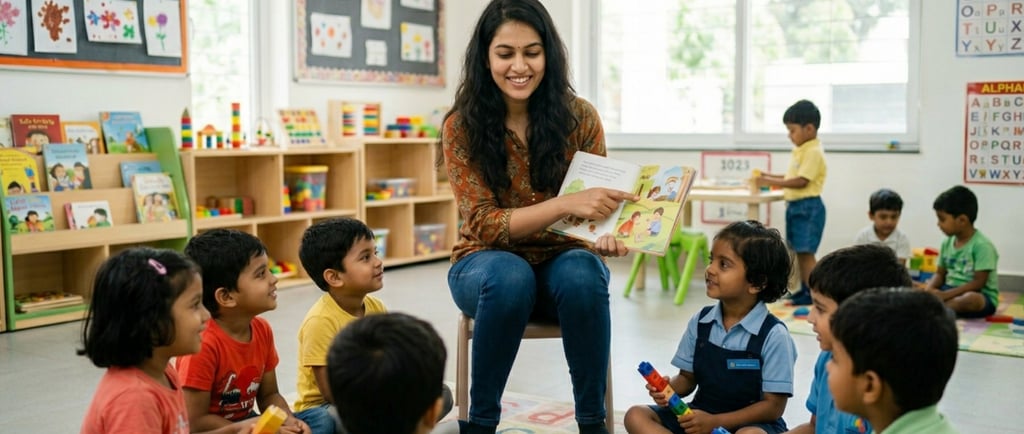

In today’s competitive educational landscape, the phrase “school readiness” has quietly transformed from a supportive concept into a source of stress—for both children and adults. What was once meant to ensure a smooth transition into formal schooling has now become a race, where toddlers are expected to read, write, and perform far beyond their developmental stage.
As educators and parents, it’s time to pause and reflect: Are we preparing children for school, or pushing them into a system before they are truly ready?
This growing concern around school readiness pressure in ECCE is not just a trend—it is a silent shift that may be impacting the emotional, cognitive, and social well-being of young learners.
What Does “School Readiness” Really Mean?
Traditionally, school readiness referred to a child’s ability to adapt to a structured environment—basic communication, emotional regulation, social interaction, and curiosity to learn. It was never meant to be about academic mastery.
However, today, readiness is often measured through:
Early literacy (reading simple words)
Writing skills
Number recognition and counting
Ability to sit still and follow instructions
This shift has redefined childhood itself.
At LevelUp Online Education, we emphasize that readiness is not about performance, but about preparedness of the whole child—emotionally, socially, and cognitively.
The Hidden Pressure Behind Early Achievement
The pressure doesn’t always look obvious. It hides in:
Comparison with peers
School admission criteria
Social media parenting standards
Fear of “falling behind”
Parents, often with the best intentions, enroll children in multiple classes—phonics, abacus, handwriting—believing they are giving them an advantage.
But here’s the reality:
Children are not falling behind. Expectations are racing ahead.
The rise of school readiness pressure in ECCE has created an environment where learning is no longer joyful—it becomes performative.
The Developmental Mismatch We Often Ignore
One of the most critical yet overlooked facts in early childhood education is this:
The brain development of children aged 2–6 is not wired for structured academic learning.
At this stage, children learn best through:
Play
Exploration
Sensory experiences
Social interaction
Forcing formal learning too early can lead to:
Cognitive overload
Reduced creativity
Increased anxiety
When school readiness pressure in ECCE overrides developmental needs, we are not accelerating learning—we are interrupting natural growth.
Emotional Impact: The Invisible Damage
While early academic skills may appear impressive on the surface, the emotional cost often goes unnoticed.
Children under constant pressure may:
Develop fear of failure
Lose intrinsic motivation
Associate learning with stress
Show behavioral resistance
A child who is repeatedly corrected, pushed, or compared may begin to believe:
“I am not good enough.”
This is where the real harm lies.
The long-term effects of school readiness pressure in ECCE can extend into:
Low self-esteem
Academic burnout
Lack of curiosity
And once curiosity is lost, true learning becomes difficult to restore.
Are We Confusing Readiness with Compliance?
Another critical question we must ask is:
Are we preparing children to learn, or training them to obey?
Many “ready” children today are those who:
Sit quietly
Follow instructions
Complete worksheets
But are these the skills that truly matter?
Real readiness includes:
Asking questions
Expressing thoughts
Solving problems
Building relationships
When school readiness pressure in ECCE prioritizes compliance over curiosity, we risk creating passive learners instead of thinkers.
The Role of Parents: Awareness Over Anxiety
Parents play a powerful role in shaping early learning experiences. However, the pressure they feel often translates into pressure on the child.
Instead of asking:
❌ “Can my child read before school?”
Try asking:
✅ “Is my child confident, curious, and emotionally secure?”
Simple shifts can make a huge difference:
Allow unstructured playtime
Reduce comparison with other children
Focus on effort, not outcomes
Encourage exploration over perfection
Understanding the realities of school readiness pressure in ECCE helps parents make informed, conscious decisions rather than fear-driven ones.
The Role of Educators: Redefining Success
Educators are not just facilitators of learning—they are protectors of childhood.
At LevelUp Online Education, teacher training programs focus on helping educators:
Understand developmental milestones
Design play-based learning environments
Balance structure with flexibility
Recognize emotional cues in children
A well-trained educator knows:
Readiness is not a checklist—it is a journey.
When teachers resist the pressure to “produce results” and instead focus on nurturing growth, children thrive naturally.
What True School Readiness Should Look Like
Let’s redefine readiness in a way that truly benefits children.
A school-ready child is someone who:
Feels safe and secure in new environments
Can communicate needs and emotions
Shows curiosity and willingness to explore
Can engage socially with peers
Has basic self-help skills
Notice what’s missing?
There is no mention of reading, writing, or academic achievement.
Because these skills can be taught when the child is ready.
But emotional security and curiosity must be nurtured early.
Reducing school readiness pressure in ECCE allows these foundational qualities to develop organically.
The Long-Term Perspective We Often Miss
Here’s a powerful truth:
Early academic advantage does not guarantee long-term success.
Research consistently shows that children who are pushed academically too early often:
Plateau in later years
Lose interest in learning
Experience higher stress levels
On the other hand, children who experience:
Play-based learning
Emotional support
Exploration-driven environments
…develop stronger problem-solving skills, creativity, and resilience.
When we remove school readiness pressure in ECCE, we are not delaying success—we are building it sustainably.
A Thoughtful Way Forward
This is not about rejecting school readiness altogether. It is about redefining it with intention and awareness.
We need a collective shift:
From pressure → to preparedness
From performance → to process
From comparison → to individuality
Parents, educators, and institutions must work together to protect the essence of early childhood.
Because childhood is not a race.
It is a foundation.
Final Reflection
If a child learns to read early, it may impress us today.
But if a child learns to love learning, it will empower them for life.
The question is not:
“Is the child ready for school?”
The real question is:
“Is the system ready for the child?”
Understanding and addressing school readiness pressure in ECCE is not just an educational responsibility—it is a moral one.
Northern Hills Supremus, A-306, Opp. Northern Heights, Dahisar East, Mumbai, Maharashtra 400068
LevelUp
admissions@leveluponline.in
© 2026. All rights reserved
levelup_online_education



LevelUp Online Education