Mirror Neurons in Early Childhood Learning: How Young Minds Learn by Observing
Discover the role of mirror neurons in early childhood learning and how they shape behavior, empathy, and skill development. Learn how educators at LevelUp Online Education use this science to enhance teaching.
EARLY CHILDHOOD CARE EDUCATION
LevelUp Online Education
4/29/20263 min read
The Silent Teachers in a Child’s Brain
Have you ever noticed how a child instinctively imitates a teacher’s tone, a parent’s gesture, or even another child’s behavior? This isn’t just mimicry—it’s neuroscience at work. At the heart of this fascinating process lies the concept of mirror neurons in early childhood learning, a powerful mechanism that shapes how young children absorb the world around them.
In early childhood, learning doesn’t happen only through instruction—it happens through observation, emotion, and connection. Understanding this can transform the way educators and parents approach teaching.
What Are Mirror Neurons?
Mirror neurons are specialized brain cells that activate both when a child performs an action and when they observe someone else performing the same action. In simple terms, children “mirror” what they see.
For example:
When a teacher smiles warmly, a child’s brain registers and often replicates that emotion.
When a peer shares toys, other children are more likely to imitate that behavior.
This is why mirror neurons in early childhood learning are considered foundational to how children develop skills, habits, and social understanding.
Why Mirror Neurons Matter in Early Childhood
Early childhood is a critical phase where the brain is rapidly developing. During this time, children are highly sensitive to their environment.
The importance of mirror neurons in early childhood learning lies in their ability to:
Accelerate language acquisition
Shape social behavior
Build emotional intelligence
Encourage imitation-based learning
Unlike older learners, young children don’t rely heavily on logic or instruction—they rely on observation. What they see becomes what they do.
Learning Through Observation: More Powerful Than You Think
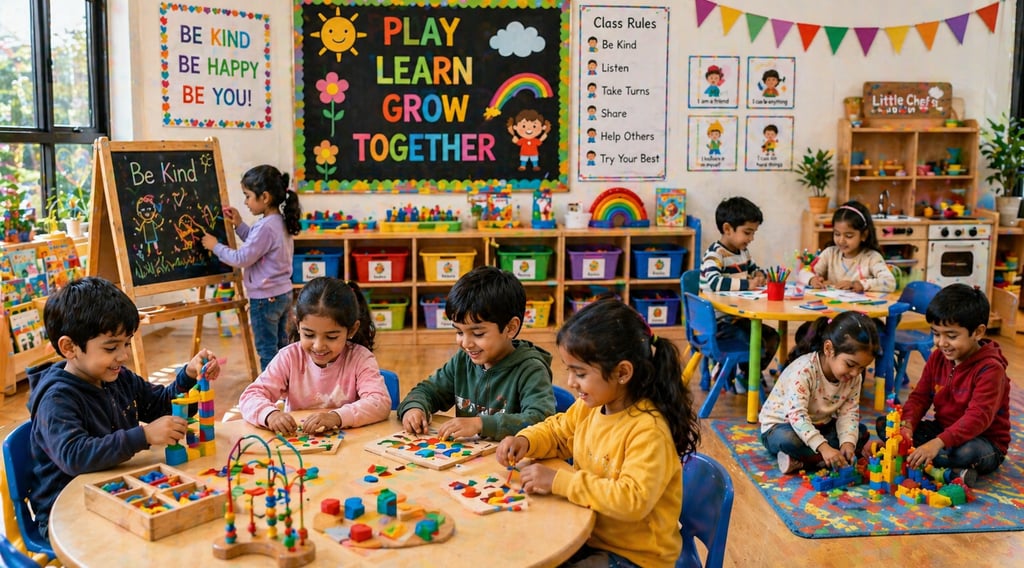
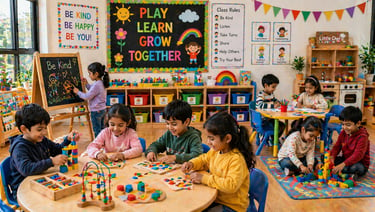
Think about a preschool classroom. Even without direct teaching:
A child learns how to hold a pencil by watching others
They learn classroom etiquette by observing routines
They adopt communication styles from teachers
This is the direct impact of mirror neurons in early childhood learning—learning happens organically, almost effortlessly.
However, this also means children absorb everything, including negative behaviors. That’s why the learning environment becomes critically important.
The Teacher as a Living Curriculum
In early childhood education, teachers are not just instructors—they are role models.
Every gesture, tone, and reaction becomes a learning opportunity. Through the lens of mirror neurons in early childhood learning, teaching is not just about what you say, but how you behave.
A calm teacher:
Creates calm children
An enthusiastic teacher:
Builds curious learners
An empathetic teacher:
Nurtures emotionally secure children
This shifts the role of educators from content deliverers to behavioral architects.
Building Empathy and Emotional Intelligence
One of the most profound impacts of mirror neurons in early childhood learning is on emotional development.
When children observe:
Kindness → they practice kindness
Sharing → they learn cooperation
Comforting gestures → they develop empathy
This is how emotional intelligence is formed—not through lectures, but through lived experiences.
Children don’t just understand emotions—they feel them through observation. That’s the magic of mirror neurons.
Practical Classroom Strategies for Educators
Understanding this concept is powerful—but applying it is transformative.
Here’s how educators can intentionally use mirror neurons in early childhood learning:
1. Model Desired Behavior Consistently
Children imitate consistency. If you want respectful communication, demonstrate it daily.
2. Use Demonstration Over Instruction
Instead of saying “share your toys,” show sharing in action.
3. Create Positive Peer Interactions
Children learn as much from peers as from teachers. Encourage collaborative play.
4. Be Emotionally Expressive
Let children see healthy emotional responses—this helps them understand and regulate their own feelings.
5. Maintain a Calm and Structured Environment
Chaos breeds imitation too. A calm classroom leads to calm behavior.
How LevelUp Online Education Applies This Science
At LevelUp Online Education, teacher training goes beyond theory—it integrates neuroscience into practical teaching strategies.
Understanding mirror neurons in early childhood learning is a key part of their training approach.
Educators are trained to:
Be conscious role models
Use demonstration-based teaching
Create emotionally safe classrooms
Encourage observational learning
This ensures that teachers don’t just teach—they influence.
LevelUp emphasizes that in ECCE, who the teacher is matters as much as what the teacher teaches.
Common Misconceptions You Should Avoid
While the concept is powerful, it’s often misunderstood.
1. “Children only learn by imitation”
Truth: Imitation is a foundation, but not the only method.
2. “Good behavior can be forced”
Truth: Behavior is absorbed, not imposed.
3. “Teaching is about instructions”
Truth: Teaching is about modeling.
Recognizing the true role of mirror neurons in early childhood learning helps avoid ineffective teaching practices.
Why This Matters More Than Ever Today
In today’s fast-paced, digital world, children are exposed to multiple influences—screens, media, and varied environments.
This makes the role of real-life modeling even more critical.
When educators and parents become intentional about their behavior, they:
Reduce negative imitation
Promote healthy habits
Strengthen social-emotional skills
Understanding mirror neurons in early childhood learning is no longer optional—it’s essential for effective teaching.
Final Thoughts: Teaching Beyond Words
Early childhood education is not just about alphabets and numbers—it’s about shaping human beings.
Children are constantly watching, absorbing, and becoming.
The real question is:
What are we showing them?
When educators understand the science behind mirror neurons in early childhood learning, they unlock a deeper, more meaningful way of teaching—one that goes beyond instruction and touches transformation.
Northern Hills Supremus, A-306, Opp. Northern Heights, Dahisar East, Mumbai, Maharashtra 400068
LevelUp
admissions@leveluponline.in
© 2026. All rights reserved


levelup_online_education




LevelUp Online Education