
How to Handle School Refusal in Preschoolers | LevelUp Online Education
Learn how to handle school refusal in preschoolers with practical strategies, emotional insights, and expert tips from LevelUp Online Education.
PRESCHOOL MANAGEMENT
LevelUp Online Education
5/7/20264 min read
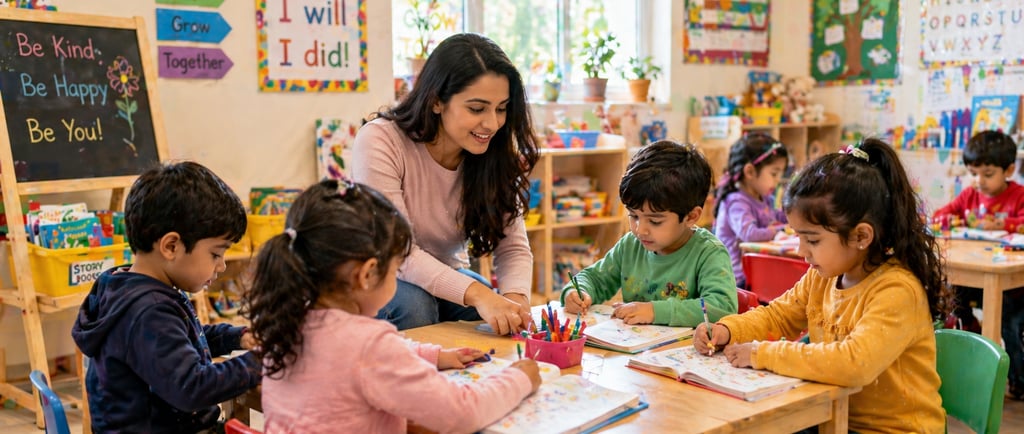
Every preschool teacher and parent has faced this moment—the child clings tightly, tears welling up, repeating the same sentence: “I don’t want to come to school.”
While it may seem like a phase or simple stubbornness, this situation often runs deeper. Understanding and addressing school refusal in preschoolers requires sensitivity, patience, and the right strategies.
At LevelUp Online Education, we believe that every child’s emotional experience matters just as much as their academic growth. Let’s explore how educators and parents can respond effectively.
Understanding the Root: Why Do Children Refuse School?
Before jumping into solutions, it’s important to pause and ask: Why is the child resisting?
School refusal in preschoolers is rarely about laziness. It often stems from emotional or environmental triggers such as:
Separation anxiety from parents
Fear of unfamiliar surroundings
Difficulty adjusting to routines
Negative past experiences (scolding, isolation, etc.)
Social discomfort with peers
At this stage, children are still developing emotional language. So instead of saying “I feel anxious,” they express it as “I don’t want to go.”
The refusal is not the problem—it’s a signal.
The Emotional Lens: What the Child Is Really Saying
When a child refuses school, they are often communicating:
“I don’t feel safe yet.”
“I am overwhelmed.”
“I need more reassurance.”
Recognizing this shifts the response from discipline to empathy.
Handling school refusal in preschoolers becomes easier when educators and parents stop seeing it as defiance and start seeing it as emotional communication.
Step 1: Build Emotional Safety Before Academic Engagement
Children learn best when they feel secure. The first goal is not to force attendance—but to create a sense of belonging.
What educators can do:
Greet the child warmly by name
Maintain eye contact and a calm tone
Offer a familiar object or comfort activity
Avoid rushing the separation process
What parents can do:
Establish a consistent goodbye routine
Avoid sneaking away (it breaks trust)
Reassure the child that you will return
When emotional safety is prioritized, resistance naturally reduces.
Step 2: Create a Gentle Transition Routine
Transitions are difficult for young children. A predictable routine can make a big difference.
Try this structured approach:
Arrival ritual (hug, wave, or special phrase)
Immediate engagement (favorite toy/activity ready)
Teacher connection (1:1 attention for a few minutes)
Consistency builds trust. Over time, children begin to associate school with predictability rather than uncertainty.
This is especially crucial when dealing with school refusal in preschoolers, as unpredictability often fuels anxiety.
Step 3: Use Play as a Bridge to Comfort
Play is a child’s natural language. Instead of forcing participation, invite them into playful engagement.
Examples:
Role-play “going to school” using toys
Let the child take on a “helper role” in class
Use storytelling to normalize feelings
When children feel involved rather than instructed, their resistance reduces significantly.
Step 4: Avoid Labeling or Forcing
Statements like:
“Stop crying”
“Big kids don’t behave like this”
“You have to go to school”
…can intensify fear and shame.
Instead, try:
“I see you’re feeling upset. That’s okay.”
“We will go step by step together.”
Handling school refusal in preschoolers requires emotional validation—not pressure.
Step 5: Strengthen Teacher-Child Bonding
A strong emotional connection with the teacher can transform a child’s experience.
Teachers can:
Spend one-on-one time daily (even 3–5 minutes matters)
Remember small details about the child (favorite toy, color, story)
Use positive reinforcement genuinely
When the teacher becomes a “safe adult,” school becomes less intimidating.
Step 6: Partner With Parents, Not Against Them
One of the biggest mistakes is creating a disconnect between home and school.
Instead, build a partnership:
Share daily updates with parents
Understand the child’s home routine
Align strategies (same goodbye routine, same reassurance language)
At LevelUp Online Education, we emphasize collaborative communication as a key skill for educators.
Consistency between home and school is essential when addressing school refusal in preschoolers.
Step 7: Identify Red Flags Early
While occasional resistance is normal, persistent refusal may indicate deeper concerns.
Watch for:
Frequent physical complaints (stomach aches, headaches)
Extreme clinginess beyond initial weeks
Withdrawal from activities
Sudden behavioral changes
In such cases, early intervention is important. This may include:
Counseling support
Classroom adjustments
Parent guidance sessions
Ignoring prolonged school refusal in preschoolers can impact emotional development and long-term learning attitudes.
Step 8: Celebrate Small Wins
Progress may be slow—and that’s okay.
Celebrate:
Entering the classroom without crying
Staying for a few extra minutes
Participating in one activity
Avoid expecting overnight transformation.
Each small step builds confidence and reduces fear.
The Role of Teacher Training in Handling Such Situations
Not every teacher instinctively knows how to handle emotional challenges in children. That’s where structured training becomes essential.
At LevelUp Online Education, educators are trained to:
Understand child psychology deeply
Respond with empathy instead of authority
Create emotionally safe classrooms
Handle real-life situations like school resistance
Because teaching is not just about delivering lessons—it’s about understanding children.
A Gentle Reminder for Educators and Parents
A child refusing school is not being “difficult.”
They are being honest.
They are expressing something they don’t yet have the words for.
Handling school refusal in preschoolers is less about control and more about connection.
When we listen, support, and guide with patience, we don’t just help them attend school—we help them trust the world outside their comfort zone.
Conclusion: From Resistance to Readiness
“I don’t want to come to school” can feel like a challenge—but it’s actually an opportunity.
An opportunity to:
Build trust
Strengthen emotional resilience
Create a positive learning foundation
Northern Hills Supremus, A-306, Opp. Northern Heights, Dahisar East, Mumbai, Maharashtra 400068
LevelUp
admissions@leveluponline.in
© 2026. All rights reserved


levelup_online_education




LevelUp Online Education