ECCE vs NTT: Eligibility, Curriculum, Career Scope & Key Differences Explained
ECCE vs NTT: Eligibility, curriculum structure, child impact, career scope, and key differences explained in detail. A complete decision guide with logical FAQs to help you choose the right path.
ECCE VS NTT
LevelUp Online Education
2/16/20263 min read


When considering a career in early childhood education, one of the most common questions is about ECCE vs NTT. Both courses prepare individuals to work with young children, yet they differ in philosophy, depth, and long-term career scope.
This guide offers a structured, neutral, and holistic understanding of both programs so that you can make an informed decision based on your goals, interests, and professional aspirations.
Step 1: Understanding What ECCE and NTT Actually Mean
What Is ECCE?
ECCE (Early Childhood Care and Education) is a comprehensive program focused on the holistic development of children from birth to six years of age.
It integrates:
Child psychology
Developmental milestones
Brain development
Play-based learning
Emotional and social growth
Inclusive education practices
Observation and assessment
ECCE training goes beyond classroom instruction. It helps educators understand how children think, feel, and learn during their formative years.
What Is NTT?
NTT (Nursery Teacher Training) is a course designed primarily to prepare teachers for nursery and kindergarten classrooms.
It emphasizes:
Lesson planning
Classroom routines
Teaching rhymes and phonics basics
Activity-based learning
Behavior management
Creative teaching aids
NTT focuses more on practical classroom delivery and structured early academic preparation.
Step 2: How These Courses Shape a Child’s Life
Early childhood is a critical period for:
Brain development
Emotional security
Language acquisition
Social skill formation
Self-confidence building
Impact of ECCE Training on Children
Teachers trained in ECCE learn:
How early experiences shape neural connections
How to identify developmental delays
How emotional safety affects learning ability
How to design age-appropriate environments
Such training encourages responsive teaching rather than reactive discipline.
A child guided by an educator with strong developmental understanding often develops stronger emotional regulation and learning confidence.
Impact of NTT Training on Children
Teachers trained in NTT develop:
Classroom structure skills
Routine consistency
Activity-based engagement techniques
Foundational literacy and numeracy support
Children benefit from structured learning, routine stability, and organized exposure to early academic concepts.
In the discussion of ECCE vs NTT, it is important to understand that both contribute meaningfully—but through slightly different approaches.
Step 3: What Teachers Learn Beyond Textbooks
Choosing between ECCE vs NTT is also about personal transformation.
In ECCE, teachers develop:
Observation skills
Emotional intelligence
Sensitivity toward child behavior
Individualized instruction methods
Inclusive classroom planning
They learn to interpret behavior as communication rather than misconduct.
In NTT, teachers develop:
Practical teaching delivery
Classroom control techniques
Lesson structuring
Activity facilitation
Parent interaction basics
They gain confidence in managing nursery classrooms effectively.
Step 4: Eligibility and Course Duration
Eligibility for both courses generally includes:
Completion of 10+2 (any stream)
Interest in working with young children
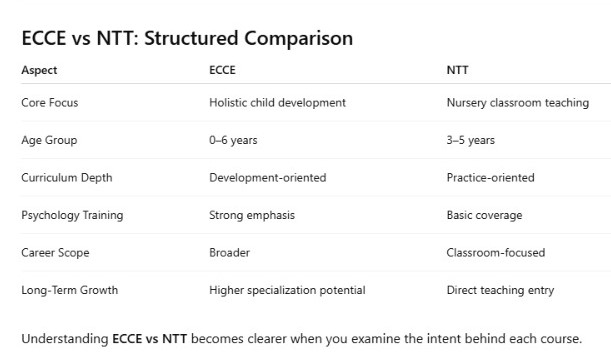
ECCE programs may be more detailed and sometimes longer in duration, depending on curriculum structure.
NTT programs are often shorter and focused on quicker classroom readiness.
When evaluating ECCE vs NTT, duration and depth are important considerations.
Step 5: Career Scope and Professional Growth
After ECCE
Career opportunities may include:
Preschool educator
Curriculum designer
Early childhood coordinator
Child development consultant
Administrative roles (with experience)
ECCE often opens broader developmental and leadership pathways.
After NTT
Career opportunities may include:
Nursery teacher
Kindergarten teacher
Assistant teacher
Activity instructor
NTT offers direct classroom entry and practical teaching opportunities.
Understanding ECCE vs NTT in terms of long-term growth helps align your decision with future goals.
How Teacher Behavior Influences Child Development
Regardless of the course chosen, a teacher’s behavior significantly impacts children.
Young learners:
Mirror emotional tone
Respond to patience and warmth
Internalize adult reactions
An educator trained in child psychology (often emphasized in ECCE) may approach challenges with deeper emotional understanding.
An educator trained in structured classroom techniques (often emphasized in NTT) may provide consistent routines and clear boundaries.
Both contribute to healthy learning environments when applied responsibly.
How to Decide Between ECCE and NTT
Consider the following:
Do you enjoy understanding child psychology deeply? → ECCE
Do you prefer practical classroom execution? → NTT
Do you want broader career growth opportunities? → ECCE
Do you want quicker classroom entry? → NTT
The discussion of ECCE vs NTT is not about superiority, but alignment with your goals.
Frequently Asked Questions
1. Is ECCE more valuable than NTT?
Not necessarily. ECCE offers broader developmental knowledge, while NTT focuses on nursery-level teaching skills. Value depends on your career objective.
2. Can I pursue ECCE after completing NTT?
Yes. Some educators choose NTT first for practical experience and later pursue ECCE for specialization and career expansion.
3. Is NTT sufficient to become a nursery teacher?
In many cases, yes. NTT prepares individuals specifically for nursery classroom roles.
4. Does ECCE offer better long-term growth?
ECCE may provide broader opportunities due to its developmental depth, especially in curriculum planning or coordination roles.
5. Which course is better for someone restarting their career?
Both are suitable. ECCE may provide deeper understanding, while NTT may allow quicker classroom entry.
6. Do both courses include practical training?
Most structured programs include teaching practice or internships, which are crucial for real-world readiness.
Final Thoughts
Understanding ECCE vs NTT requires clarity about your interest, long-term goals, and preferred teaching style.
Both courses contribute significantly to shaping children’s early experiences.
The early years influence:
Emotional stability
Cognitive growth
Learning confidence
Social development
The educator’s knowledge, sensitivity, and approach play a central role in this transformation.
Northern Hills Supremus, A-306, Opp. Northern Heights, Dahisar East, Mumbai, Maharashtra 400068
LevelUp
admissions@leveluponline.in
© 2026. All rights reserved


levelup_online_education




LevelUp Online Education