Canva and Teaching Psychology: Creating Visual Learning Experiences in ECCE
Discover how visual learning in ECCE becomes more effective when Canva is combined with teaching psychology. Learn practical strategies, real-life classroom examples, and design principles that truly help children learn.
CANVA COURSE FOR TEACHERS
LevelUp Online Education
5/12/20265 min read
In today’s digital world, creating educational visuals has become easier than ever. With platforms like Canva, teachers can design colorful worksheets, flashcards, schedules, posters, and presentations within minutes. But an important question often gets ignored:
Do attractive visuals automatically improve learning?
Not always.
Many educational designs look beautiful but fail to truly teach children. Young learners do not absorb information simply because a worksheet is colorful or a classroom poster has cute animations. Real learning happens when visual design is connected with how children think, process emotions, remember information, and interact with the world around them.
This is where teaching psychology becomes essential.
Understanding child psychology helps educators create visuals that are not just aesthetically pleasing but developmentally meaningful. In early childhood classrooms, visuals influence attention span, emotional comfort, memory retention, curiosity, and classroom participation. When teachers combine psychology with thoughtful design, visual learning in ECCE becomes far more powerful and impactful.
At LevelUp Online Education, educators are increasingly encouraged to move beyond decorative teaching and focus on purposeful learning experiences that support real child development.
Why Children Learn Better Through Visuals
Children in the early years are naturally visual learners. Before they fully develop reading and writing skills, they understand the world through observation, facial expressions, colors, shapes, movement, and imagery.
Think about a preschool child entering a classroom for the first time. They may not read instructions, but they instantly notice:
Bright colors
Friendly illustrations
Emotion charts
Picture schedules
Symbol-based labels
Visual routines
These visuals create psychological safety and familiarity.
Research in child development shows that visual cues reduce anxiety and improve understanding because young children process images faster than text. This is one reason why visual learning in ECCE is considered one of the strongest approaches in early education.
However, not all visuals are equally effective.
A classroom overloaded with bright graphics, too many fonts, excessive stickers, and distracting animations can actually overwhelm children. Their brains struggle to focus on the main learning objective.
Good educational visuals simplify learning instead of complicating it.
The Psychology Behind Effective Educational Design
Teaching psychology explains that children learn best when information is:
Emotionally engaging
Easy to process
Repetitive but meaningful
Connected to real experiences
Organized visually
This means a teacher designing on Canva should not only ask:
“What looks nice?”
They should also ask:
“What helps children understand better?”
For example, imagine a teacher creating a “Daily Routine” chart.
Ineffective Version:
Neon background
Ten different fonts
Cartoon overload
Tiny text
Too many decorative elements
Children may find it exciting for a few seconds, but it becomes visually exhausting.
Effective Version:
Soft contrasting colors
Clear icons
Simple sequence
Large visuals
Minimal distractions
This design supports predictability and emotional regulation.
That is the real purpose of visual learning in ECCE — helping children process information calmly and confidently.
Real-Life Classroom Scenario: The Power of Visual Simplicity
A preschool teacher noticed that her students struggled during transition times between activities. Every day, children became restless when moving from playtime to snack time.
Initially, she verbally repeated instructions multiple times:
“Keep the toys away.”
“Wash your hands.”
“Sit properly.”
But the classroom still felt chaotic.
Later, she created a visual transition chart using Canva:
Toy picture → Keep toys back
Handwashing icon
Snack image
Sitting mat picture
Within two weeks, transitions became smoother.
Why?
Because visuals reduced cognitive overload. Children no longer depended entirely on verbal processing. They could see the sequence and follow it independently.
This is a practical example of how visual learning in ECCE supports classroom management while also building confidence and self-regulation.
Emotional Psychology Matters in Design Too
Children emotionally respond to visuals more deeply than adults often realize.
Colors, facial expressions, and visual arrangements can influence mood and behavior.
For example:
Soft blues and greens create calmness.
Warm yellows create friendliness.
Overly bright red backgrounds may increase overstimulation.
Similarly, visuals showing smiling children, empathy, kindness, and inclusion make classrooms emotionally welcoming.
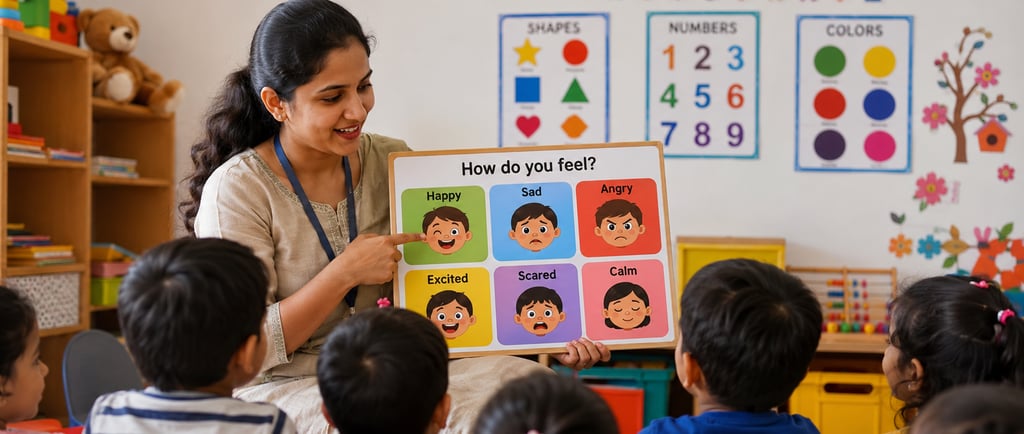
Imagine a child who feels nervous or isolated. A visual emotions board with simple facial expressions can help them communicate feelings even before they fully develop emotional vocabulary.
This is why emotionally intelligent design is becoming an important part of visual learning in ECCE.
Teachers are not simply decorating classrooms anymore. They are designing emotional environments.
Canva as a Tool — Not the Teacher
One major mistake educators make is relying too heavily on technology itself.
Canva is powerful, but the platform alone does not guarantee learning outcomes. The educator’s understanding of children remains the most important factor.
For example:
A beautifully designed alphabet poster may fail if it is visually cluttered.
A simple handmade visual may succeed if it connects with children meaningfully.
The goal should never be “making things pretty.”
The goal should be:
Better understanding
Better engagement
Better retention
Better emotional connection
When used thoughtfully, Canva supports teachers in creating structured and psychologically effective materials for visual learning in ECCE.
Designing for Different Learning Styles
Every child learns differently.
Some children respond strongly to pictures.
Some need movement.
Some connect with storytelling.
Others need repetition and sensory engagement.
Canva allows teachers to adapt visuals for multiple learning styles by creating:
Picture-based stories
Visual schedules
Interactive flashcards
Emotion charts
Sequencing activities
Sensory-friendly worksheets
For example, a child with speech delays may benefit more from image-supported communication cards than verbal explanations alone.
Similarly, neurodivergent learners often feel more secure when routines are represented visually.
This flexibility is what makes visual learning in ECCE especially valuable in inclusive classrooms.
The Problem with “Pinterest Classrooms”
Social media has created pressure for classrooms to look “Instagram-worthy.”
Teachers sometimes spend hours creating highly aesthetic displays that impress adults but confuse children.
Huge decorative walls, crowded posters, glitter-heavy charts, and visually noisy learning corners may look trendy online but can reduce concentration in real classrooms.
Teaching psychology reminds us that children need:
Clarity
Structure
Predictability
Focused stimulation
A classroom should support learning, not compete for attention.
Effective educators understand that simplicity often teaches more effectively than excessive decoration.
This shift in mindset is essential for meaningful visual learning in ECCE.
Building Memory Through Visual Consistency
Children remember concepts better when visuals are consistent.
For example:
Using the same color coding repeatedly
Maintaining familiar symbols
Repeating visual patterns
Keeping layouts predictable
This strengthens memory pathways.
Imagine if a teacher always uses:
Green for positive behavior
Blue for reading
Yellow for creativity
Over time, children begin associating colors with concepts naturally.
This psychological reinforcement improves recall and classroom understanding.
Consistency is one of the most underestimated aspects of visual learning in ECCE.
How Teachers Can Create More Meaningful Visuals
Before designing anything on Canva, teachers can ask themselves:
1. What is the learning goal?
The design should support a specific objective.
2. Is the visual age-appropriate?
Young children need simple, large, and clear visuals.
3. Is the design emotionally safe?
Avoid overwhelming or fear-based imagery.
4. Can children understand it independently?
Good visuals reduce over-dependence on verbal instruction.
5. Does it support inclusion?
Use diverse characters, emotions, and accessible layouts.
These small reflective questions transform ordinary teaching materials into psychologically supportive learning tools.
The Future of Teaching Is Thoughtful, Not Just Digital
Technology will continue transforming education, especially in ECCE. But the future does not belong to teachers who simply use digital tools.
It belongs to educators who understand children deeply.
A Canva design becomes meaningful only when it reflects:
Child psychology
Emotional understanding
Developmental appropriateness
Real classroom needs
Children may forget fancy graphics, but they remember learning experiences that made them feel safe, curious, confident, and understood.
That is the true power of visual learning in ECCE.
Northern Hills Supremus, A-306, Opp. Northern Heights, Dahisar East, Mumbai, Maharashtra 400068
LevelUp
admissions@leveluponline.in
© 2026. All rights reserved
levelup_online_education


LevelUp Online Education