
Abacus and Cognitive Development: What’s Really Happening in the Brain of a Child?
Discover how abacus and cognitive development are connected through memory, focus, visualization, and brain activation. Learn how abacus training shapes young minds in real-world learning situations.
FINGER ABACUS
LevelUp Online Education
5/13/20264 min read

In many classrooms today, children are surrounded by screens, quick entertainment, and short attention spans. Parents often worry about one common issue — “Why is my child unable to focus for long?” Teachers notice that some children struggle with memory retention, mental calculations, and confidence in academics. Amidst all these concerns, one ancient learning tool continues to surprise modern researchers: the abacus.
But is abacus learning only about faster calculations?
Not really.
Modern cognitive science is now exploring how abacus training affects the brain itself. Researchers, educators, and psychologists are discovering that abacus learning activates multiple regions of the brain simultaneously, strengthening essential cognitive abilities in children. This is why conversations around abacus and cognitive development are becoming increasingly important in education today.
The fascinating part is that the benefits often extend far beyond mathematics.
The Brain Is Like a Muscle
Just like physical exercise strengthens the body, mental activities strengthen the brain. During early childhood, the brain develops rapidly. Neural pathways are constantly forming based on experiences, repetition, and learning environments.
When children practice abacus regularly, they are not simply memorizing numbers. They are engaging in:
Visualization
Finger coordination
Concentration
Auditory processing
Memory retention
Mental imagination
All these processes happen together at the same time.
This is why experts studying abacus and cognitive development often describe abacus training as a “whole-brain exercise.”
What Happens Inside the Brain During Abacus Learning?
To understand this better, let us imagine a real classroom scenario.
A 7-year-old child is solving a mental addition problem during an abacus class. Initially, the child physically moves beads on the abacus. Over time, however, something remarkable happens — the child starts imagining the abacus inside the mind.
This process is called “mental visualization.”
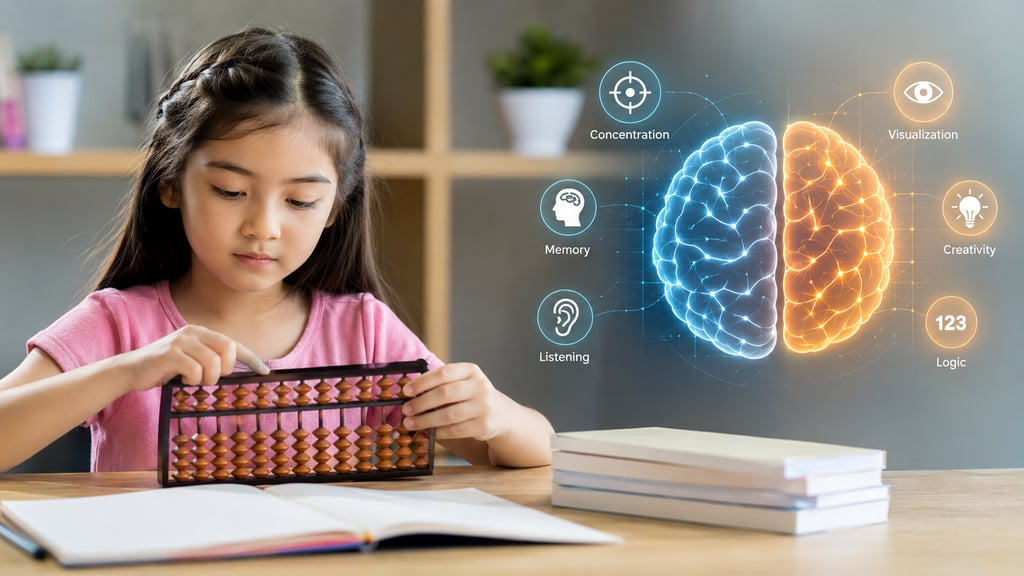
The child begins to “see” imaginary beads moving mentally while solving calculations. Cognitive scientists believe this activates both the left and right hemispheres of the brain simultaneously.
The left brain is involved in:
Logic
Numbers
Analysis
Sequential thinking
The right brain contributes to:
Visualization
Creativity
Imagination
Spatial awareness
This balance is one of the strongest reasons educators connect abacus and cognitive development so closely.
Visualization: The Hidden Superpower
One of the most overlooked skills in children today is visualization.
Many students memorize information without truly imagining concepts. Abacus changes this pattern completely. Children are trained to build mental images constantly.
For example, when solving:
245 + 132
879 – 467
The child mentally visualizes bead movement instead of depending only on written methods.
This strengthens:
Mental imagery
Working memory
Processing speed
Attention control
In real life, visualization helps children in surprising ways.
A child who develops strong visualization skills may:
Understand science diagrams faster
Imagine story scenes while reading
Remember classroom instructions better
Improve creative thinking
This practical connection between abacus and cognitive development is what makes abacus education more meaningful than many people initially assume.
Why Concentration Improves in Abacus Students
Many parents notice a common transformation after a few months of abacus training — their children become calmer and more attentive.
Why does this happen?
Because abacus demands sustained focus.
If a child loses concentration for even a few seconds during mental calculations, the answer may go wrong. Gradually, the brain learns to maintain attention for longer periods.
This is especially valuable in today’s distraction-heavy environment where:
Notifications interrupt learning
Children multitask constantly
Screen dependency reduces attention span
Abacus acts almost like mental discipline training.
Several teachers have observed that students practicing abacus regularly often:
Finish homework faster
Listen more carefully in class
Show improved classroom participation
Develop patience during learning activities
This is another powerful example of how abacus and cognitive development influence overall learning behavior.
The Role of Finger Movement in Brain Activation
Interestingly, finger movement itself plays a major role in cognitive stimulation.
When children physically move abacus beads using precise finger techniques, the brain’s motor cortex becomes highly active. Finger coordination is directly connected to neural development in young children.
This is why hands-on learning methods are so effective during early childhood education.
Think about toddlers:
Stacking blocks
Holding crayons
Building puzzles
All these activities stimulate brain growth through movement.
Similarly, abacus finger movements strengthen:
Coordination
Fine motor skills
Brain-body synchronization
Researchers exploring abacus and cognitive development often emphasize that physical interaction during learning improves cognitive engagement significantly.
Confidence: The Emotional Side of Cognitive Growth
Cognitive science is not only about memory and calculations. Emotional development also affects how children learn.
Imagine a child who usually fears mathematics suddenly solving calculations mentally within seconds. The emotional impact can be huge.
The child starts believing:
“I can do difficult things.”
“I am smart.”
“I can learn faster.”
Confidence changes learning behavior dramatically.
Children who gain confidence through abacus often become more willing to:
Answer questions in class
Participate in competitions
Try challenging subjects
Speak openly during discussions
This emotional boost is an important part of abacus and cognitive development because self-belief strongly influences academic performance.
Real-World Scenario: A Distracted Child Finds Focus
Consider a real-life example many parents may relate to.
A mother enrolls her 8-year-old son in abacus classes because he struggles with concentration. Teachers complain that he gets distracted easily and forgets instructions.
Initially, the child finds mental calculations difficult. But after several months of consistent practice:
His listening skills improve
He starts completing tasks independently
He remembers classroom lessons better
His confidence increases
What changed?
The brain gradually adapted to repeated cognitive training.
This is exactly why discussions around abacus and cognitive development are receiving more attention among educators and parents worldwide.
Can Abacus Make Every Child a Genius?
This is a common misconception.
Abacus is not magic.
It does not instantly transform every child into a mathematical genius. Every child learns differently, develops at a different pace, and has unique strengths.
However, abacus can strengthen foundational cognitive abilities that support learning overall.
The goal should not only be faster arithmetic.
The real value lies in helping children:
Think clearly
Focus deeply
Process information efficiently
Build confidence
Strengthen memory
When approached correctly, abacus and cognitive development become connected through long-term mental growth rather than short-term performance.
Why Early Childhood Is the Best Time
The early years are often called the “golden period” of brain development.
During this stage:
Neural connections form rapidly
Learning habits develop
Cognitive flexibility is high
This is why introducing structured mental activities during early childhood can have a lasting impact.
Abacus learning during these years may help children build:
Stronger attention control
Better memory habits
Improved visualization abilities
Faster mental processing
For parents and educators, understanding the connection between abacus and cognitive development can help them make more informed learning choices for children.
The Future of Learning: Ancient Tools + Modern Science
Ironically, one of the oldest mathematical tools is now being supported by modern neuroscience.
In a world dominated by artificial intelligence and digital learning, human cognitive skills remain extremely valuable. The ability to focus, visualize, think critically, and process information efficiently will continue to matter in every field.
Abacus training reminds us that true education is not only about marks or speed.
It is about developing the mind itself.
The growing research around abacus and cognitive development highlights an important truth: when children engage both imagination and logic together, learning becomes deeper, stronger, and more meaningful.
Northern Hills Supremus, A-306, Opp. Northern Heights, Dahisar East, Mumbai, Maharashtra 400068
LevelUp
admissions@leveluponline.in
© 2026. All rights reserved


levelup_online_education




LevelUp Online Education