5 Essential Jolly Phonics Skills Every Teacher Should Master for Effective Early Literacy
Discover the most important Jolly Phonics skills every teacher should know. Learn how these skills improve phonics teaching, strengthen early literacy, and help children read and spell with confidence.
ESSENTIAL SKILLS FOR JOLLY PHONICS TEACHERS
LevelUp Online Education
3/16/20264 min read
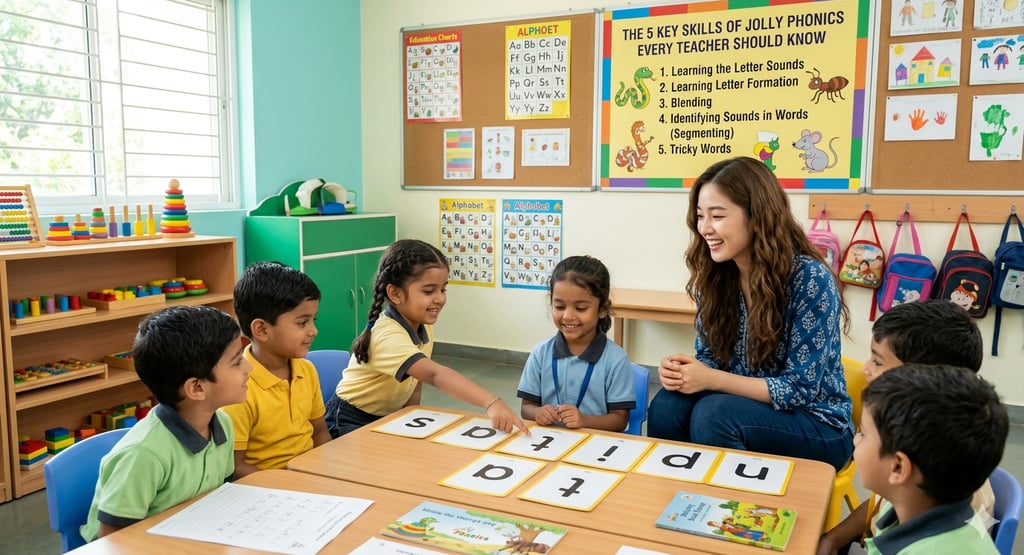
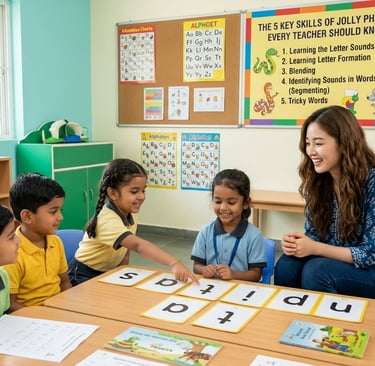
Early literacy is one of the most important foundations in a child’s educational journey. When children learn to read and write with confidence at an early age, it positively shapes their academic growth for years to come. Among the many phonics-based approaches used in early education, Jolly Phonics stands out as a highly effective and engaging method that helps children master reading and spelling through a structured and multisensory approach.
At the heart of this method lie essential Jolly Phonics skills that teachers must understand deeply to guide young learners successfully. When educators develop these skills, they can create classrooms where children not only learn phonics but also develop a genuine love for language.
In this article, we will explore the five key skills of Jolly Phonics, why they are important for teachers to master, and how they positively influence both teaching effectiveness and student learning outcomes.
Why Teachers Must Master Jolly Phonics Skills
Before diving into the five skills, it is important to understand why mastering Jolly Phonics skills matters so much for educators.
Teaching phonics is not simply about introducing letters and sounds. It requires a structured strategy, the ability to engage children actively, and a deep understanding of how young minds process language. Teachers who are well trained in Jolly Phonics skills can make learning interactive, meaningful, and easier for children to grasp.
When teachers strengthen these skills, they gain the confidence to teach phonics systematically while helping children decode words, spell accurately, and read fluently.
1. Sound Recognition (Learning Letter Sounds)
The first and most fundamental skill in Jolly Phonics is sound recognition. Instead of starting with the alphabet in its traditional order, children learn the sounds of letters in a specific sequence that helps them begin reading quickly.
For teachers, mastering this skill means understanding how to introduce sounds clearly and consistently. Children must learn not just the letter name but the sound associated with it.
How Teachers Can Upgrade This Skill
Teachers can strengthen this skill by:
Practicing correct sound pronunciation
Using visual aids and flashcards
Incorporating actions and gestures for each sound
Using songs and storytelling to reinforce sounds
A strong foundation in sound recognition is one of the most important Jolly Phonics skills because it allows children to start decoding words independently.
Impact on Students
When teachers teach sounds effectively, children develop early confidence in reading. They begin recognizing sounds in words around them and feel motivated to explore language further.
2. Letter Formation (Writing the Sounds)
The second important skill is letter formation, which focuses on teaching children how to write letters correctly.
Writing letters is not just about forming shapes; it is about developing muscle memory, fine motor skills, and correct writing habits from the beginning. Teachers must guide students to write letters in the correct direction and sequence.
Among the essential Jolly Phonics skills, letter formation plays a crucial role in connecting reading and writing.
How Teachers Can Improve This Skill
Teachers can enhance their teaching of letter formation by:
Demonstrating proper writing strokes
Using multisensory materials like sand trays or clay
Encouraging air writing and tracing activities
Providing consistent practice through guided worksheets
Impact on Students
Children who learn correct letter formation early develop better handwriting skills and stronger writing confidence. This also supports their spelling abilities as they begin forming words independently.
3. Blending Sounds for Reading
Blending is the process of combining individual letter sounds to form words. It is one of the most powerful skills that helps children transition from recognizing sounds to actually reading words.
For example, when children learn the sounds /c/ /a/ /t/, they must blend them together to read the word cat. Teachers must guide students step by step until blending becomes automatic.
Blending is considered one of the core Jolly Phonics skills because it directly enables children to read.
How Teachers Can Strengthen This Skill
Teachers can improve blending instruction by:
Using word-building activities
Practicing sound stretching exercises
Introducing simple three-letter words first
Encouraging group reading and phonics games
Impact on Students
When children master blending, reading suddenly becomes easier and more enjoyable. They realize they can decode unfamiliar words, which boosts their confidence and curiosity to read more.
4. Segmenting Sounds for Spelling
While blending helps children read words, segmenting helps them spell.
Segmenting means breaking a word into its individual sounds. For instance, the word dog can be segmented into /d/ /o/ /g/. Children then use this understanding to spell the word correctly.
Teachers who understand how to teach segmentation effectively can significantly improve students’ spelling abilities. This is why segmentation is one of the essential Jolly Phonics skills every teacher should master.
How Teachers Can Upgrade This Skill
Teachers can develop better segmentation teaching strategies by:
Using sound boxes or phoneme frames
Encouraging children to tap out sounds
Practicing dictation exercises
Using interactive spelling activities
Impact on Students
Segmenting strengthens spelling accuracy and phonemic awareness. Children become more independent writers because they can break words into sounds and reconstruct them in written form.
5. Tricky Words Recognition
In English, not all words follow regular phonetic rules. Words like said, was, and the cannot be fully decoded using phonics alone. These are known as tricky words.
Teachers must help students recognize these words quickly so that reading becomes smoother and more fluent.
Understanding how to teach tricky words effectively is one of the advanced Jolly Phonics skills that helps children transition from decoding to fluent reading.
How Teachers Can Improve This Skill
Teachers can enhance tricky word instruction by:
Using flashcards and repetition
Encouraging visual memory techniques
Playing word recognition games
Practicing reading sentences containing tricky words
Impact on Students
When children learn tricky words efficiently, their reading fluency improves significantly. They can focus on understanding the meaning of sentences rather than struggling to decode every word.
The Positive Impact of Mastering Jolly Phonics Skills
When teachers invest time in mastering Jolly Phonics skills, the benefits extend far beyond phonics lessons.
1. Improved Teaching Confidence
Teachers feel more confident delivering structured phonics lessons.
2. Higher Student Engagement
Interactive phonics activities make learning enjoyable and participatory.
3. Stronger Reading Foundations
Children develop solid decoding and comprehension abilities.
4. Better Classroom Outcomes
Students progress faster in literacy when phonics is taught systematically.
5. Lifelong Learning Skills
Early literacy confidence encourages curiosity and independent learning.
How Teachers Can Continue Developing Their Phonics Expertise
To truly master phonics instruction, teachers must continuously upgrade their knowledge and teaching strategies.
Some effective ways to grow professionally include:
Attending phonics training workshops
Practicing multisensory teaching techniques
Observing experienced phonics educators
Using interactive learning tools and phonics games
Reflecting on classroom teaching practices
When educators continue refining their phonics instruction, they strengthen their mastery of Jolly Phonics skills and create a richer learning environment for children.
Conclusion
Teaching children to read is one of the most rewarding responsibilities of an educator. However, it requires the right strategies, knowledge, and teaching skills to make the learning process effective and enjoyable.
By mastering the five key Jolly Phonics skills—sound recognition, letter formation, blending, segmenting, and tricky word recognition—teachers can build strong literacy foundations for young learners. These skills not only empower educators to teach phonics confidently but also help children develop the reading and writing abilities that will support their academic journey for years to come.
Northern Hills Supremus, A-306, Opp. Northern Heights, Dahisar East, Mumbai, Maharashtra 400068
LevelUp
admissions@leveluponline.in
© 2026. All rights reserved
levelup_online_education


LevelUp Online Education